By Enrico Sieni·Revify Analytics·2026-07-30·~14 min read
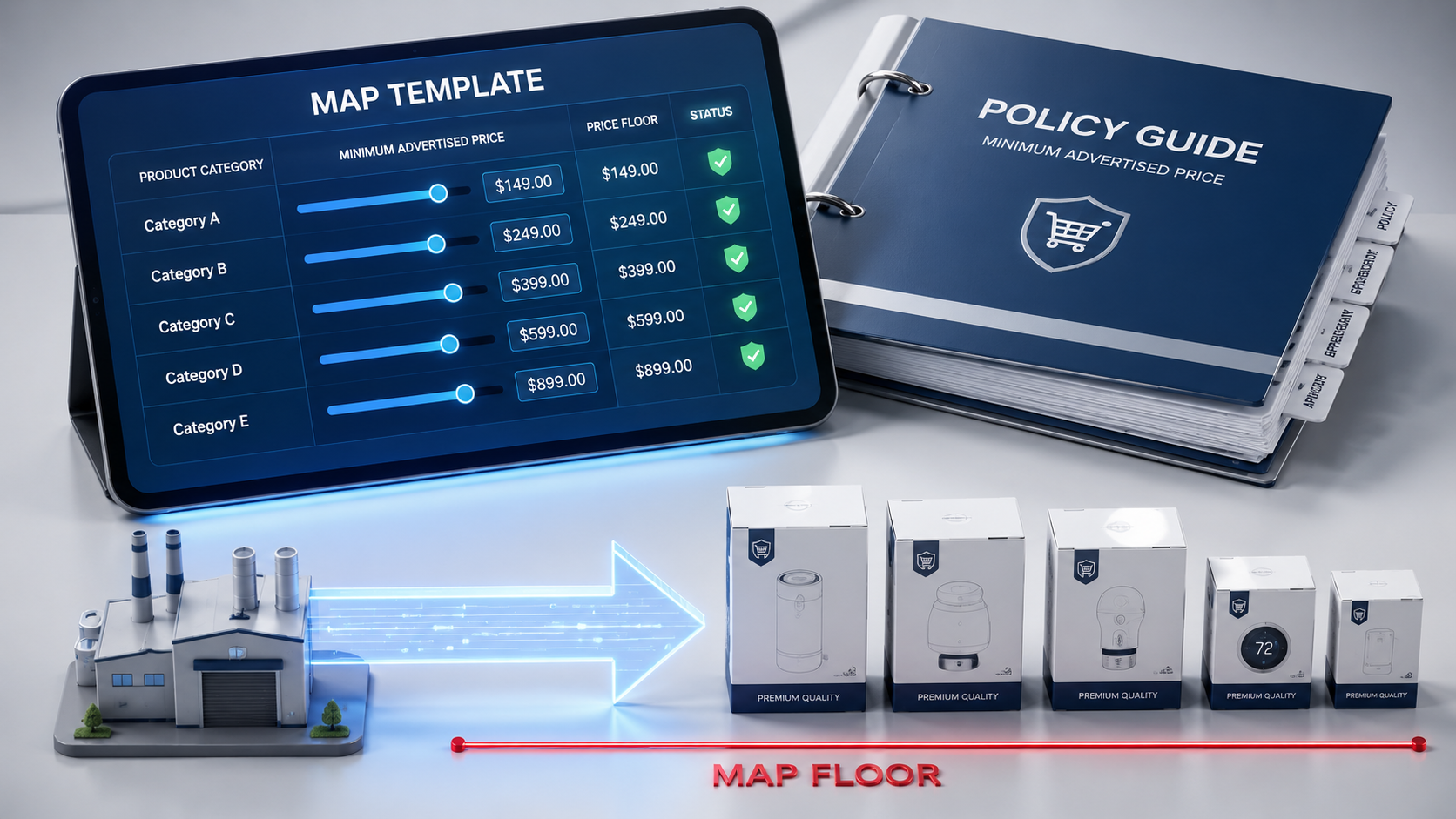
A minimum advertised price policy (MAP policy) is a manufacturer’s published floor on the price resellers may advertise for its products. It governs the advertised price only; every seller stays free to charge what it wants at checkout. This guide explains how MAP differs from MSRP and price fixing, when a MAP policy is the wrong tool, five steps to build one, a copy-and-adapt template, and how to enforce it across distributors and online resellers.
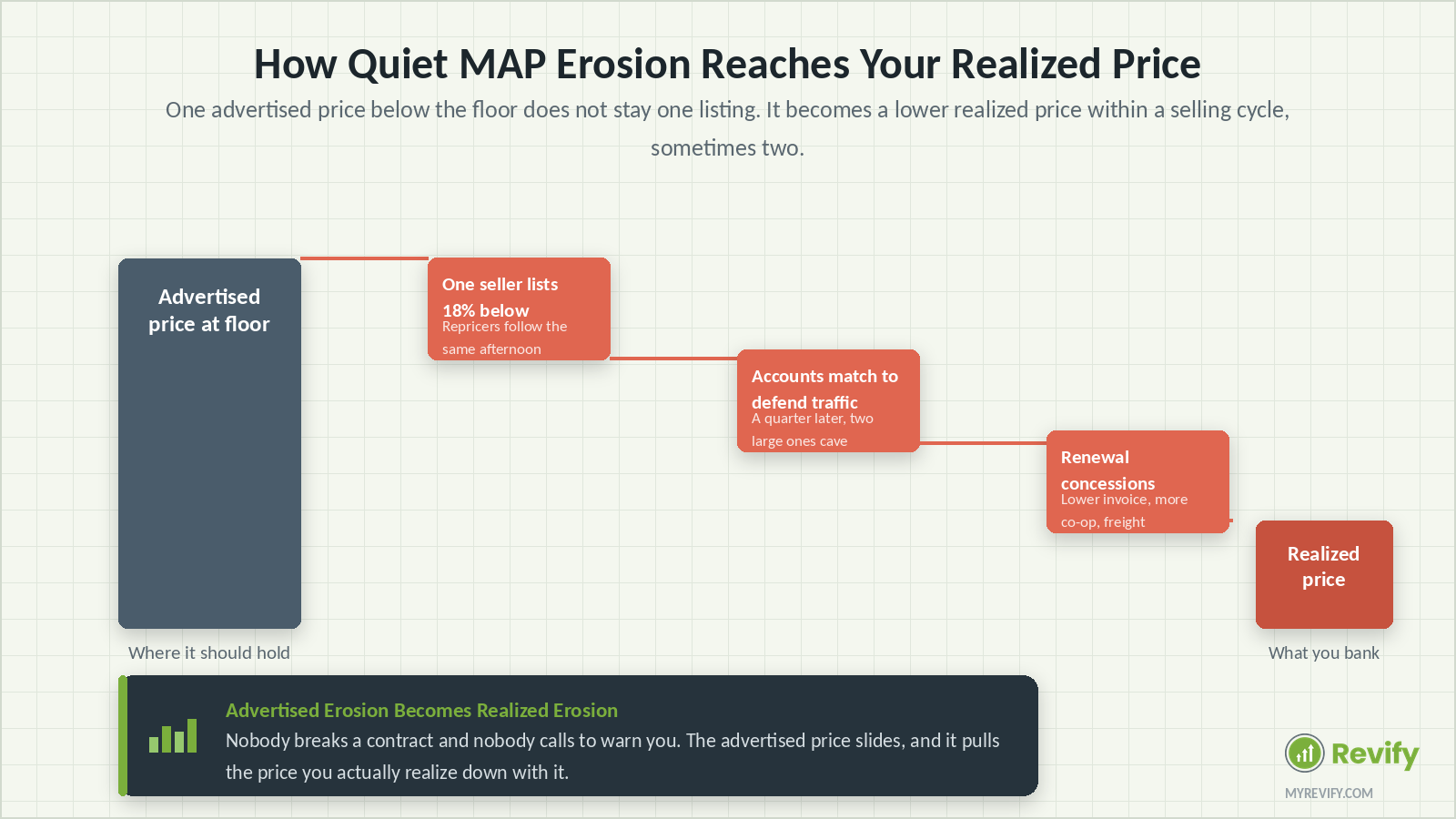
It usually starts with a screenshot. A representative from the distributor sends over a marketplace listing in which your main product is shown as 18 percent cheaper than all the others, along with a note saying, in effect, ‘Why should I keep my price when this person doesn’t have to?’ Within a quarter, two of your largest accounts have copied the listing to retain their traffic, and three months later, they are asking for more favorable invoice terms to protect their margins. No contract has been breached, and no one has contacted you about this. The advertised price has dropped, resulting in a lower realized price for you.
A simple and uninteresting approach is to introduce a MAP policy. Either way, most medium-sized manufacturers either have no such policy or have a PDF from 2019 that is not, in fact, enforced. In both situations, the company suffers a loss of actual margin. Here is how to set one up correctly.
What is considered to be a minimum advertised price policy?
A minimum advertised price policy is one that a manufacturer publishes on its own initiative and which sets the lowest price at which resellers may advertise the products in question. The important term in this case is ‘advertise’. The policy covers product pages, marketplace listings, shopping feeds, search and display ads, emails, and printed flyers. It does not apply to the checkout stage; the amount the seller charges a customer remains at the seller’s discretion, and a well-drafted MAP policy makes this clear in writing.
Manufacturers introduce a MAP policy for two reasons. The first of these concerns reseller economics. Distributors and dealers hold your products because it is in their best interest to do so. If the advertised prices continue to decline, resellers who have invested in inventory, technical support, and after-sales service are disadvantaged by those who have not made any such investments and, as a result, concentrate on brands that provide them with protection. The second reason concerns price perception. On the internet, each buyer and competing reseller can quickly see the advertised price, and a single aggressive listing can change what the market believes your product is worth.
The economics behind reason one has a name: the free-rider problem. A dealer that pays for demonstrations, stocked inventory, trained salespeople, and installation can lose the sale to a seller that pays for none of it and simply advertises a lower price. The Supreme Court relied on this logic in Leegin, and the FTC’s plain-language guidance explains the mechanism in the same way: discounters can free-ride on the service investments of full-service dealers and capture the demand those services create. A MAP policy exists largely to keep investing in your brand, worth a partner’s while.
Twenty years ago, when regional discounters set their prices, they harmed local businesses. This practice has now come to an end because price-comparison tools and online marketplaces have made it so that the lowest price available anywhere is used as the reference price everywhere, which is why manufacturers who sell through channel partners have made the MAP policy standard equipment.
What is the difference between the MAP, the MSRP, and price fixing?
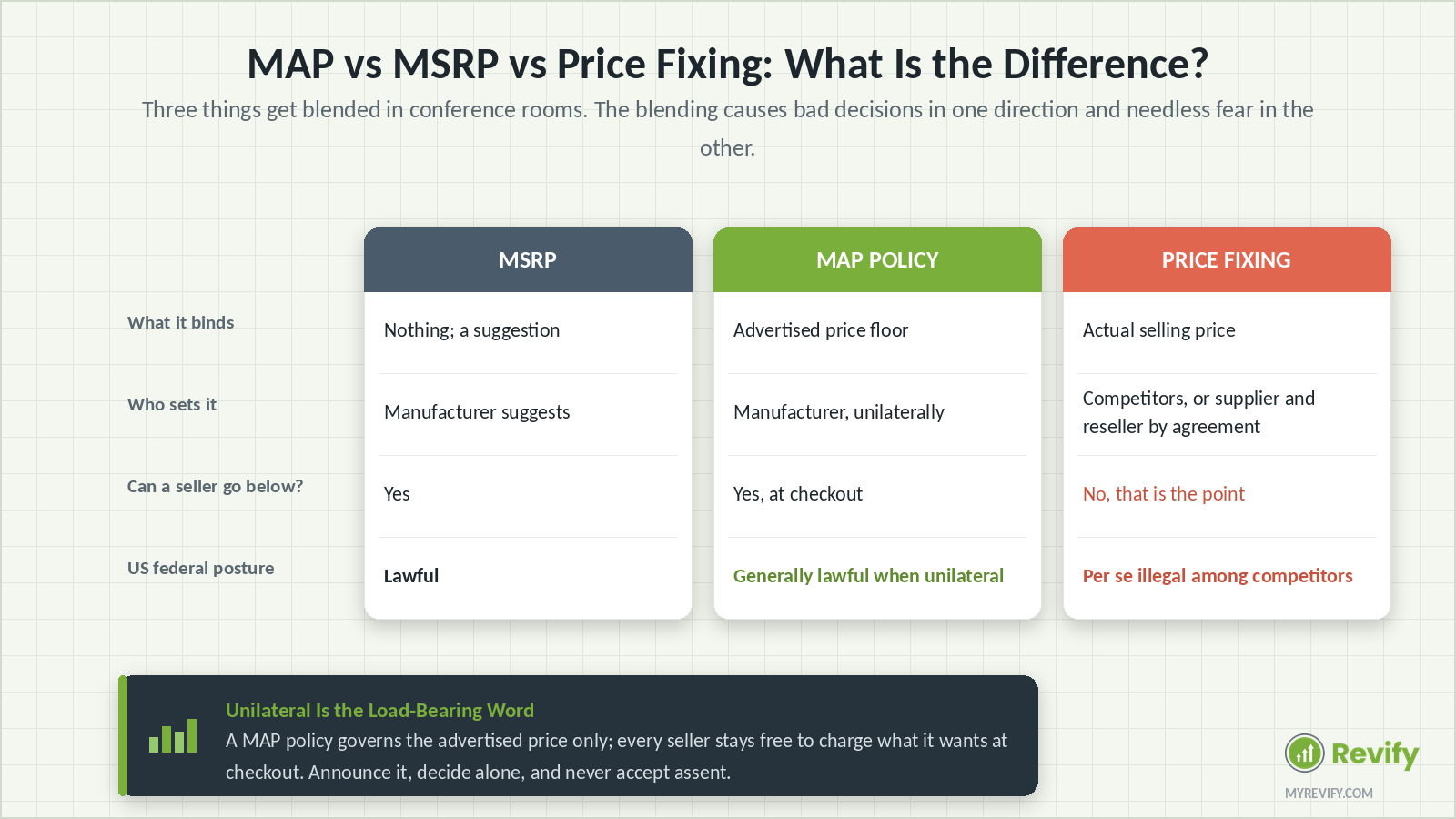
In conference rooms, the three are brought together, resulting in poor decisions in one instance and unnecessary fear in the other; the table separates them.
MSRP
MAP policy
Price fixing
What it binds
Nothing; a suggestion
Advertised price floor
Actual selling price
Who sets it
Manufacturer suggests
Manufacturer, unilaterally
Competitors, or supplier and reseller by agreement
Can a seller go below it?
Yes
Yes, at checkout
No, that is the point
US federal posture
Lawful
Generally lawful when unilateral
Per se illegal among competitors
Figure 1. A comparison of the minimum advertised price policy, the MSRP, and price fixing in terms of what is binding.
The legal lines are real but manageable, and precision matters. Since the Supreme Court’s Leegin decision in 2007, federal courts have judged minimum resale price agreements under the rule of reason instead of treating them as automatically illegal. A properly structured unilateral MAP policy is generally lawful under US federal law, with the outcome always resting on the specific facts and the states involved. Unilateral is the load-bearing word: the manufacturer announces the policy on a take-it-or-leave-it basis and decides alone how to respond to violations, a structure that federal courts have accepted since the Colgate case in 1919. Two cautions keep that structure honest. State law diverges: Maryland wrote a per se ban on minimum resale price agreements into state law in 2009, and California and New York apply their own statutes aggressively. And scope can overreach: keep the program a floor on advertised prices, because the FTC has challenged MAP programs that went further and barred retailers from advertising discounts even in ads the retailers paid for themselves.
In countries other than the United States, the situation is entirely different. Since the European Union introduced its 2022 vertical rules, minimum advertised prices have been regarded as a hard restriction if they prevent distributors from informing customers of discounts, which is why a US-type scheme is generally not transferable to Europe. In Canada, Australia, and other places, the boundaries are set independently. The legal framework referred to in this article pertains to US federal law; therefore, a company wishing to launch its initiative on a multinational basis must obtain local legal advice in each market.
We can therefore establish two practical rules: the MAP policy should be drafted as a policy rather than as an agreement included in a distributor contract, and legal advice must be obtained from someone who specializes in antitrust before the final version is adopted. Although this article is intended as a guide for operators, it does not provide legal advice.
Why does the fact that MAP wears down when it’s quiet end up costing you more than you realize?
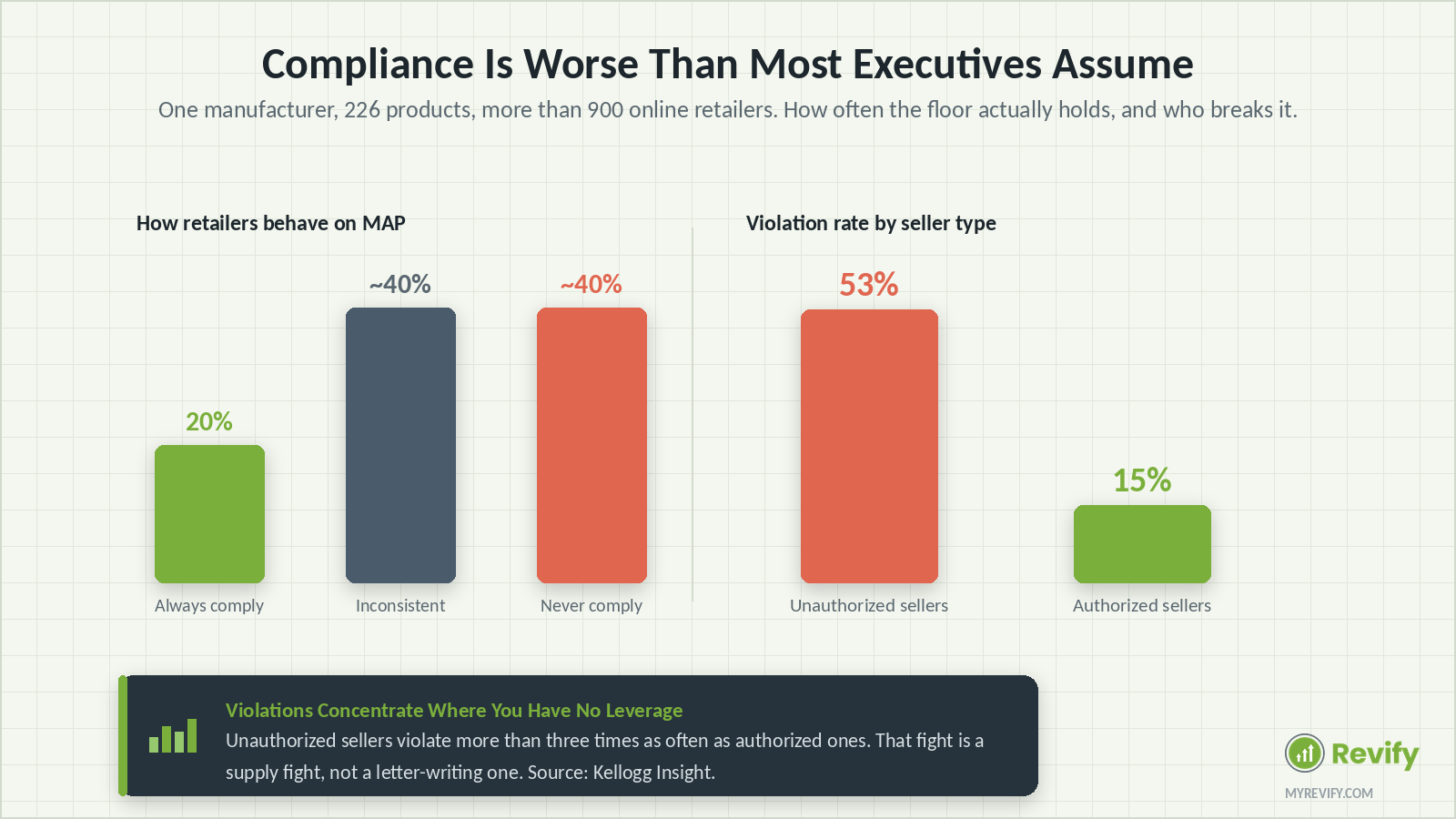
Compliance is worse than most executives assume. Researchers Ayelet Israeli, Eric Anderson, and Anne Coughlan tracked 226 products from one large manufacturer across more than 900 online retailers. Twenty percent of retailers always complied with the manufacturer’s MAP policy. Nearly forty percent never complied at all. Unauthorized sellers violated 53 percent of the time, compared with 15 percent for authorized sellers. And violations spread by imitation: authorized retailers who watched peers undercut, with no visible consequences, followed suit.
Figure 2 illustrates the actual state of adherence to the MAP policy: how retailers behave and which of them fail to meet the minimum price.
The impact is evident in your channel pricing since an advertised price serves as a public signal. If one seller puts your product below the floor, all the other sellers see it that same afternoon and have to decide whether to lose traffic or match the price. In most cases, they do decide to match. The accounts that have matched, then, when it’s time to renew, ask for lower invoice prices, larger co-op funds, or freight concessions to regain the margin they have lost. The decline in advertised prices turns into a decline in actual prices within one sales cycle, and at times within two.
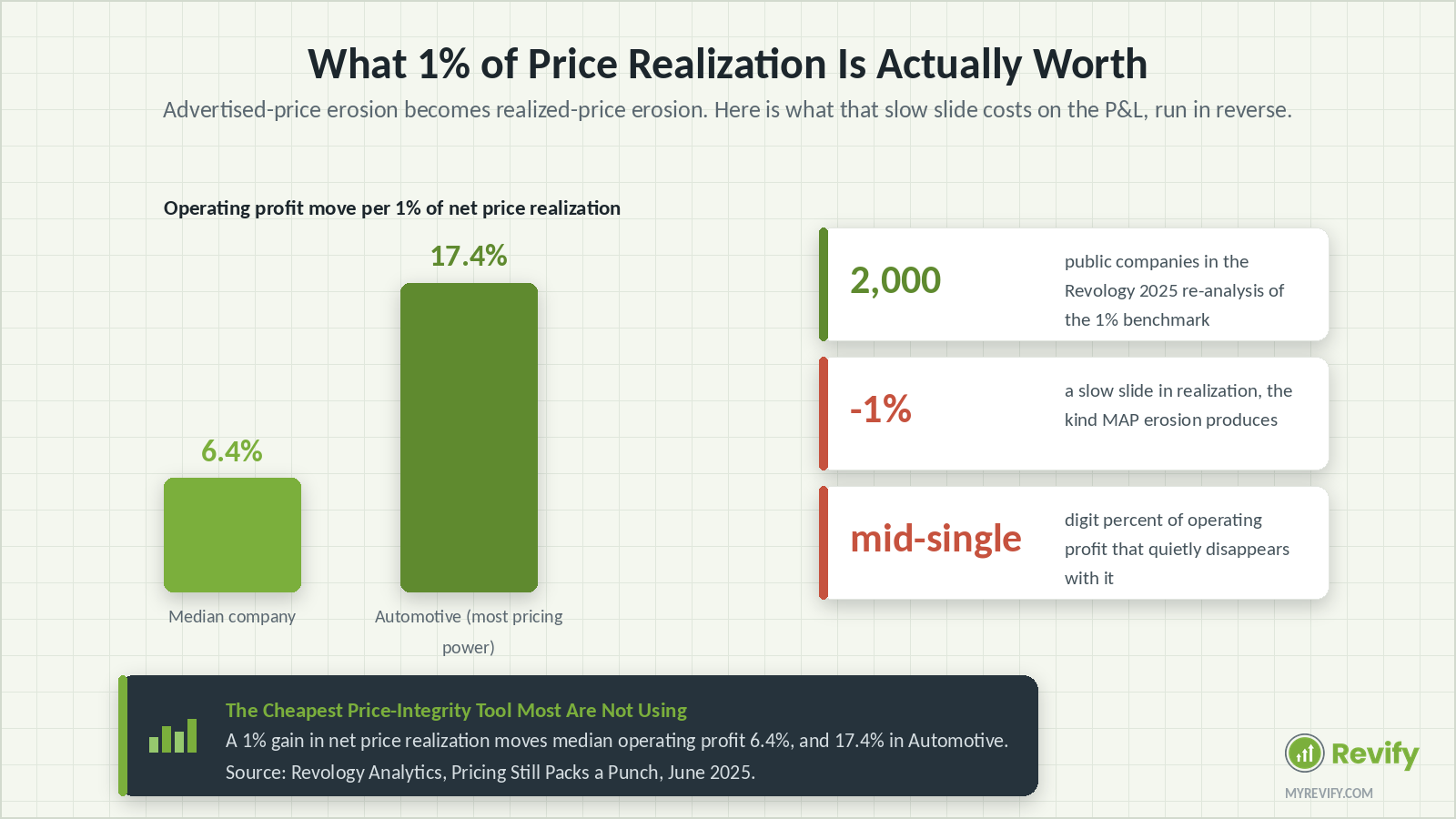
Figure 3: The way in which a floor-price advertisement becomes a lower price. The figure involved is more than the discount figures suggest. In June 2025, Revology Analytics, our other company, re-examined the well-known 1 percent pricing rule with financial data from around 2,000 publicly quoted companies. A 1 percent increase in net price realization is currently causing the median operating profit to rise by 6.4 percent and by 17.4 percent in the Automotive sector, the industry with the strongest pricing power. If the calculation is reversed, a gradual 1 percent fall in realization—such as that resulting from MAP erosion—quietly leads to a mid-single-digit reduction in operating profit. The full details of this metric are provided in How to improve price realization without a pricing team..
Refer to Figure 4, since it illustrates the value of 1 percent of net price realization in terms of operating profit.
When is a MAP policy not the appropriate tool?
Most guides on MAP assume it is the answer to all pricing complaints. It is a tool designed for use by a channel and only proves its worth when the issue lies within that channel. So, if any of the following apply to you, set this one aside at least for the moment.
You do not sell to any intermediaries, and the advertised price need not have a floor for resellers.
The products are either made to order or supplied on the basis of a quote, since there is no publicly advertised price to serve as protection.
The majority of the revenue is obtained through negotiated business-to-business contracts. Although these aspects are not given prominence, the problem in this area concerns invoice terms and the governance of discounts.
The damage resulting from the discounting is entirely your sales force’s responsibility; the matter, therefore, involves both compensation and governance, and a policy that sets minimum advertised prices for resellers will not address it.
The grey-market stocks are obtained from liquidations and warranty returns, not from leaks by distributors; that is a solution involving the supply chain and not one based on policy.
Even one more boundary, despite the fact that MAP is the appropriate tool. A MAP policy safeguards the integrity of the prices you have already established; it does not address whether or not those prices are correct. A manufacturer may be able to enforce its floor perfectly and yet still leave millions unearned because the MSRP is out of date, the channel discounts are not properly aligned, or customer-specific pricing has moved on, which is the area we discuss in cost-plus pricing and where it fails silently. Maintaining price integrity and ensuring price correctness are two separate responsibilities. Both are necessary.
Should you evaluate a MAP policy? Four questionsDo you sell through distributors, dealers, or marketplace resellers?↓ YesAre your products advertised publicly online?↓ YesAre unauthorized sellers or below-floor listings showing up?↓ YesAre your best dealers complaining about price erosion?↓ YesFour yeses and a MAP policy is worth evaluating. Any no, and your margin problem probably lives somewhere else in the waterfall.
What are the five proven steps for drawing up a minimum advertised price policy?
The MAP policy document is very short, consisting of ten sections, two pages, and a price schedule. Its effectiveness is due to the fact that a small number of decisions have to be made before the document is published, along with the discipline that is then maintained. The five steps cover both points; the template in the following section provides the appropriate language.
Step 1: Decide what the MAP policy covers
Provide a list of the products, sales channels, and geographical areas concerned. Although some manufacturers provide coverage for all their products, most start with those where price integrity is most crucial—that is, their flagship products, newly launched items, and any products that resellers use to draw in traffic. You also need to determine whether clearance of discontinued items should be excluded from the policy; it is advisable to adopt a narrow, strictly enforced policy rather than a broad one that is not enforced.
Step 2: Set the MAP level against real reseller economics
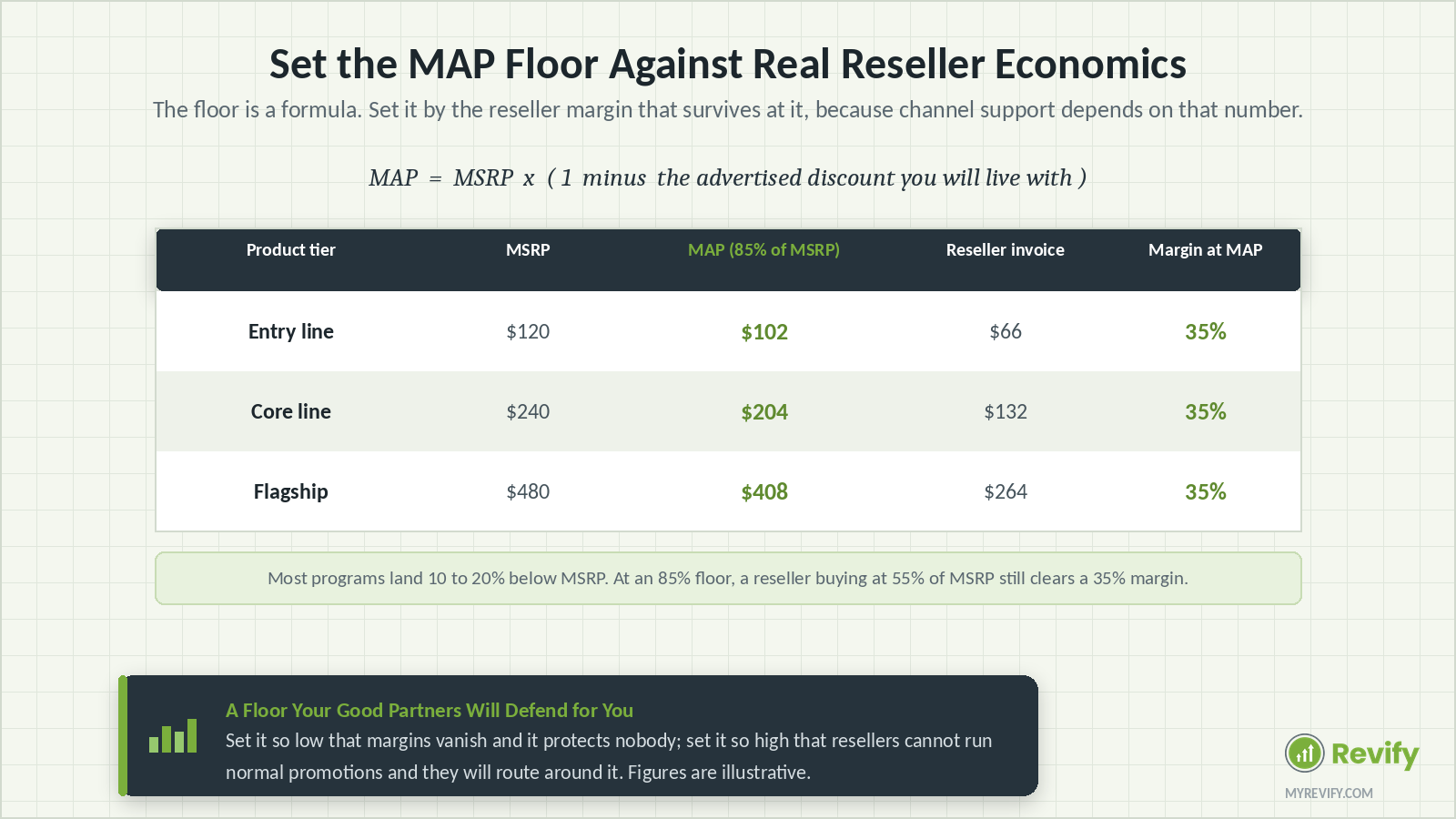
The floor is determined by the following formula: MAP equals MSRP multiplied by 1 minus the advertised discount you are willing to accept. Most programs end up being priced 10 to 20 percent below MSRP. You should set the floor based on the reseller margin that remains at the floor, since the channel support for a MAP policy relies on that figure. As an example, here are some illustrative figures:
Product tier
MSRP
MAP (85% of MSRP)
Reseller invoice
Margin at MAP
Entry line
$120
$102
$66
35%
Core line
$240
$204
$132
35%
Flagship
$480
$408
$264
35%
Figure 5. Setting the MAP floor in line with reseller economics (illustrative figures).
When the minimum advertised price is set at 85 percent, a reseller who buys at 55 percent of the manufacturer’s suggested retail price will still achieve a 35 percent profit on the advertised price. That level of the floor will be defended by your reliable partners. If the MAP floor is low enough to eliminate margins, then it offers no protection; if it is high enough to prevent resellers from running normal promotions, they will find ways to circumvent it.
Step 3: Define advertising and settle the gray areas in writing
State exactly what constitutes an advertised price. The rule set out in the table below is the one that most programs tend to adopt:
Activity
Covered by MAP?
Website or product-page price
Yes
Marketplace listing (Amazon, eBay)
Yes
Google Shopping / price feeds
Yes
Social and display ads
Yes
Email promotions
Usually yes
Printed flyers and catalogs
Yes
Telephone or in-person quotes
No
Checkout or cart price
Your call, in writing
The decision involved in the last row is one that most programs avoid. Can a price displayed only after the item has been added to the cart be considered advertising? And does it count if the coupon codes and bundles appear below the bottom of the page? Both of those answers can be defended. The reason programs don’t address them is that sellers then take advantage of the gaps.
Step 4: Build an enforcement ladder you will actually use
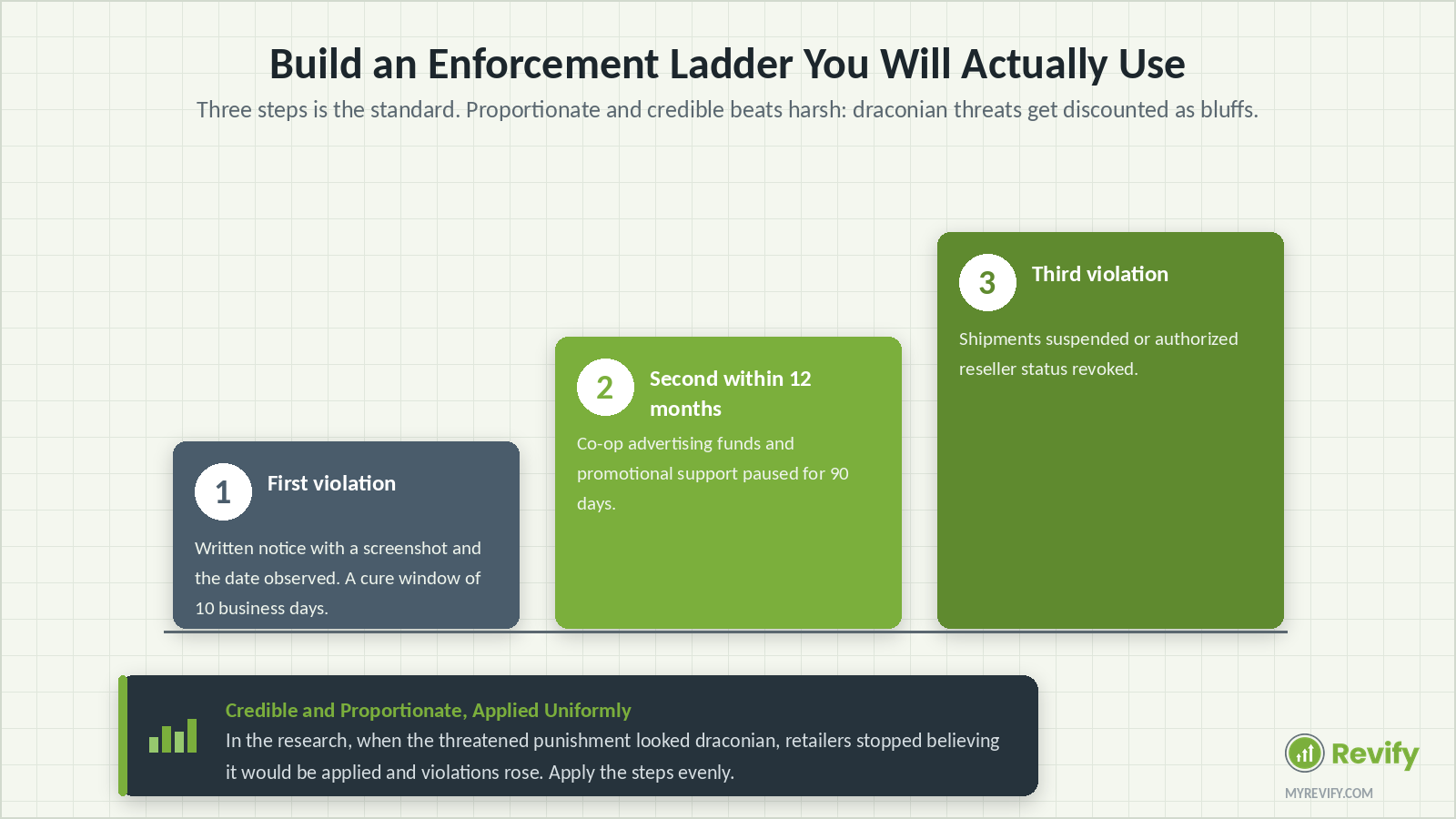
The usual rule is three steps. The first offense involves sending a written notice accompanied by a screenshot showing the date of the breach and a 10-business-day cure period. If a second offense occurs within twelve months, co-op advertising funds and promotional support are halted for ninety days. On the third offense, shipments are suspended, or the authorized status is canceled. The evidence shows that proportionate and credible penalties are more effective than severe ones; in the Kellogg study, when the threatened punishment appeared excessively harsh, the retailers ceased to believe it would actually be enforced, and the number of violations increased.
Figure 6. The ladder is used for enforcing the three-strike minimum advertised price policy.
The violation notice, in five sentencesOn [date], [Company] observed [product, SKU] advertised at [price] on [URL or marketplace], below the MAP of [price] set under [Company]’s Minimum Advertised Price Policy; a screenshot is attached. This is the [first] notice for your account. We expect the advertised price corrected within [10] business days. Under the Policy’s published enforcement steps, a second violation within [12] months suspends co-op advertising funds and promotional support for [90] days. Reply to [owner email] once corrected, or with any question about the Policy.
Step 5: Roll it out unilaterally, with one named owner
Announce the MAP policy to all resellers on the same date, publish it in a place where they can always access the latest version, and never ask anyone to sign or agree to it. Asking people to sign turns a one-sided MAP policy into something that appears to be an agreement—precisely the legal area you’ve worked to avoid. You must also state the owner’s name. A MAP policy without a named owner will become nothing more than the unenforced 2019 PDF within two quarters. Before the announcement is made, carry out the rollout checklist:
Executive sign-off on the policy and the enforcement timeline.
Legal review is complete for every state and country in which you sell.
Covered SKUs final, MAP schedule attached as Schedule A.
Policy posted at a permanent, findable location.
Announcement drafted for every reseller: same message, same day.
Monitoring the owner’s name, weekly cadence on their calendar.
The violation log was created before the first violation, not after it.
Enforcement start date announced, with a short grace period to fix existing listings.
The copy-and-adapt MAP policy template
Adapt the bracketed choices, attach your MAP schedule as Schedule A, and have antitrust counsel review the final text before you publish it to resellers.
1. Purpose[Company] has unilaterally adopted this Minimum Advertised Price Policy to preserve the value of the [Brand] name, protect the margins that fund reseller service and support, and keep price presentation consistent for customers.2. Unilateral policyThis MAP Policy is not an agreement. [Company] neither seeks nor will accept any reseller’s assent to it. [Company] alone decides whether a violation of this MAP Policy has occurred and what action to take.3. Covered productsThis MAP Policy applies to the products listed on Schedule A, as updated by [Company] from time to time. Schedule A states the MAP for each covered product.4. Advertised price floorResellers may not advertise any covered product at a price below its MAP. The MAP Policy applies to advertised prices only. Each reseller remains free to sell any product at any price it chooses.5. What counts as advertisingAdvertising includes websites, product listing pages, marketplace listings, shopping feeds, search and display ads, email campaigns, social posts, catalogs, and printed materials. A price displayed before checkout is an advertised price. A price shown only after an item is placed in the cart [is / is not] treated as advertising under this MAP Policy.6. What this Policy does not restrictThis MAP Policy does not restrict prices quoted in person or by phone, [clearance pricing on discontinued items], or pricing during promotional windows [Company] announces in writing.7. Violations and cureWhen [Company] identifies advertising below MAP, it will notify the reseller in writing with supporting evidence and the date observed. After a first violation, [Company] expects correction within [10] business days.8. EnforcementA second violation within [12] months suspends co-op advertising funds and promotional support for [90] days. The third suspends shipments or revokes authorized reseller status. [Company] applies these steps uniformly.9. Administration[Name, role] administers this MAP Policy, monitors advertised prices on a [weekly] cadence, and is the sole contact for questions about it. [Company] may amend or withdraw the Policy at any time. The current version is posted at [location].10. Effective dateThis MAP Policy takes effect on [date] and supersedes all prior versions.
How do you enforce MAP across distributors and online resellers?
MAP policy enforcement is a monitoring habit plus the will to apply the ladder evenly. The habit is a weekly sweep of advertised prices for covered SKUs, screenshots with dates, and a violation log kept by the seller. Mid-market manufacturers can run this with a spreadsheet and two hours a week; monitoring software earns its keep once you pass a few hundred SKU-seller combinations.
The violation workflowViolation detected → screenshot and timestamp saved → written notice sent → [10] business day cure window → corrected? Yes: log it and close. No, or repeated within [12] months: step two, co-op funds paused → third strike: shipments suspended or authorization revoked.
Two marketplace mechanics make today’s violations faster than the ones your 2019 policy imagined. Automated repricers monitor competing offers and adjust within minutes, so a single listing dipping below the floor can pull every repricer-driven competitor down the same afternoon. The prize structure pushes in the same direction: winning Amazon’s Featured Offer, the default add-to-cart slot buyers see first, can multiply a seller’s volume, and the advertised price weighs heavily in who wins it. Most violations now begin as software events rather than human decisions. Move fast, assume a repricer did it, and send the notice anyway.
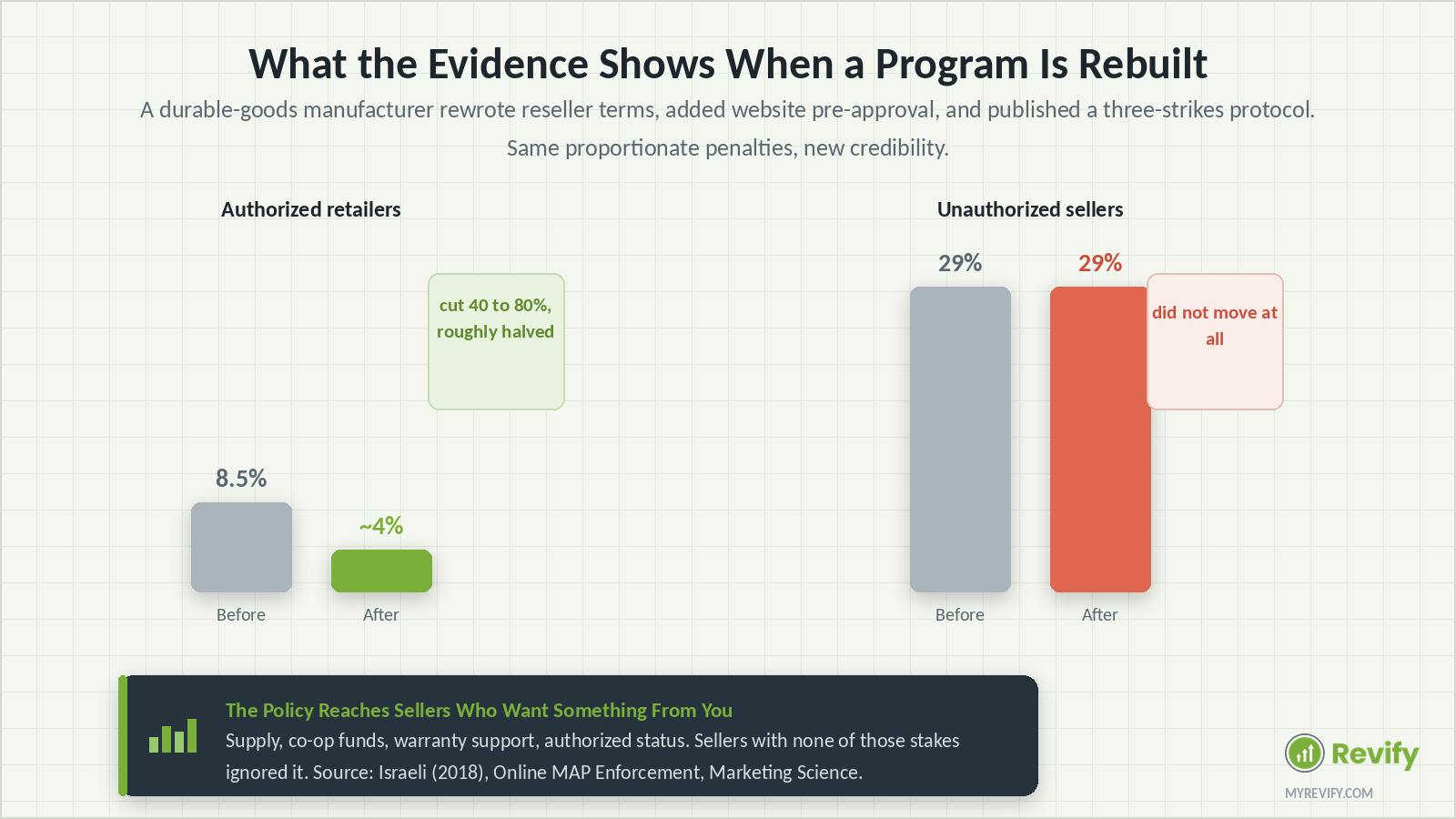
Expect the problem to concentrate on marketplaces, and specifically among sellers you never authorized. The strongest published evidence comes from a quasi-experiment inside one durable-goods manufacturer that rebuilt its MAP policy in 2012. Before the change, authorized retailers violated about 8.5 percent of the time; unauthorized sellers, about 29 percent. The manufacturer made two moves: it rewrote reseller terms for the online environment, including pre-approval of websites, and it published a three-strikes protocol that spelled out consequences in detail. Violations among authorized retailers fell 40 to 80 percent, persistently, roughly halving the rate. Unauthorized sellers did not improve at all.
Figure 7. What the evidence shows when a manufacturer rebuilds its MAP program.
That last result carries the practical lesson. A MAP policy reaches sellers who want something from you: supply, co-op funds, warranty support, and authorized status. Sellers with none of those stakes ignore it, and once your goods are lawfully sold the first time, you cannot dictate what a downstream stranger charges. So the unauthorized-seller fight is a supply fight, and it starts with knowing how gray-market sellers get product at all. The usual routes:
Distributor diversion: a partner quietly reselling into the gray market at volume.
Dealer overbuying: orders padded to hit a rebate tier, with the excess dumped online.
Liquidations and closeouts that re-enter circulation as new goods.
Customer returns and warranty stock are resold rather than scrapped.
International arbitrage occurs when your prices differ meaningfully across markets.
Employee and sample-unit resale: small volumes, corrosive precedent.
Trace listings back to their sources with serial numbers or lot codes, tighten up distributors who leak, and use marketplace brand-protection programs to challenge listings where you have grounds. Every unauthorized listing you starve of product does more than a stack of violation letters, and the same logic applies to margin leakage in general: fix the source, and the symptom fades.
Where do MAP programs break down?
Six failure modes account for nearly every MAP policy that dies. The table is the short version; the paragraph after it is the one that never makes the table.
Mistake
What it costs you
Negotiating MAP policy terms into contracts
Antitrust exposure
Selective enforcement for big accounts
Dealer trust, then compliance
No monitoring
The policy becomes decoration
No named owner
The program dies in two quarters
Penalties nobody believes
Treated as a bluff
No distributor audit
Gray market grows unchecked
The seventh failure mode is internal and the most uncomfortable. Your own sales team has a stake in looking the other way. A rep paid on volume does not want a violation letter going to the account that makes their number, and co-op funds are often the rep’s favorite negotiating chip. If compensation is based solely on volume, the field will treat the MAP policy as someone else’s problem. Put channel price integrity into the account review conversation, give the policy owner authority that does not go through the rep, and accept that the first suspended shipment will generate noise. It is also the moment the channel starts believing you. Handling that conversation with an account looks a lot like a well-run price increase; the scripts we published for communicating price changes adapt directly.
What the evidence shows: one manufacturer’s rebuildSituation: a large durable-goods manufacturer selling through hundreds of online retailers watched advertised prices erode. Authorized retailers violated MAP about 8.5 percent of the time; unauthorized sellers, about 29 percent.Actions: rewrote reseller terms for online selling, added website pre-approval, and published a three-strikes enforcement protocol with consequences spelled out in detail. Punishments stayed proportionate; what changed was credibility.Result: a persistent 40 to 80 percent reduction in violations among authorized retailers, roughly halving the violation rate, while unauthorized sellers stayed flat. Source: Israeli (2018), Online MAP Enforcement, Marketing Science.
Which KPIs tell you the policy is working?
Track a small set weekly, at the seller level, because averages hide the offenders you need to see. Split them the way pricing teams split any control metric: leading indicators that move first, lagging indicators that confirm the program is paying.
Leading indicators
Coverage rate: covered listings monitored divided by total covered listings. Monitor 40 percent of listings, and every compliance number below is fiction.
Violation rate by seller, trended weekly: the enforcement ladder is based on this number.
New unauthorized sellers per month: the earliest signal that your supply chain sprang a leak.
Median time to cure: days from notice to corrected listing. Under ten business days means the ladder has teeth.
Repeat-offender share: sellers on step two or three of the ladder. A rising share with a flat violation rate means the consequences are not landing.
Lagging indicators
Share of covered SKUs advertised at or above MAP, by channel: the cleanest read on overall price integrity.
Realized price by channel: the downstream confirmation. If advertised integrity improves and invoice-level realization does not follow within two quarters, the leak is somewhere else in the waterfall.
Channel margin: whether the partners whose policy exists to protect are actually getting healthier.
Where does your program sit? The Revify MAP maturity model
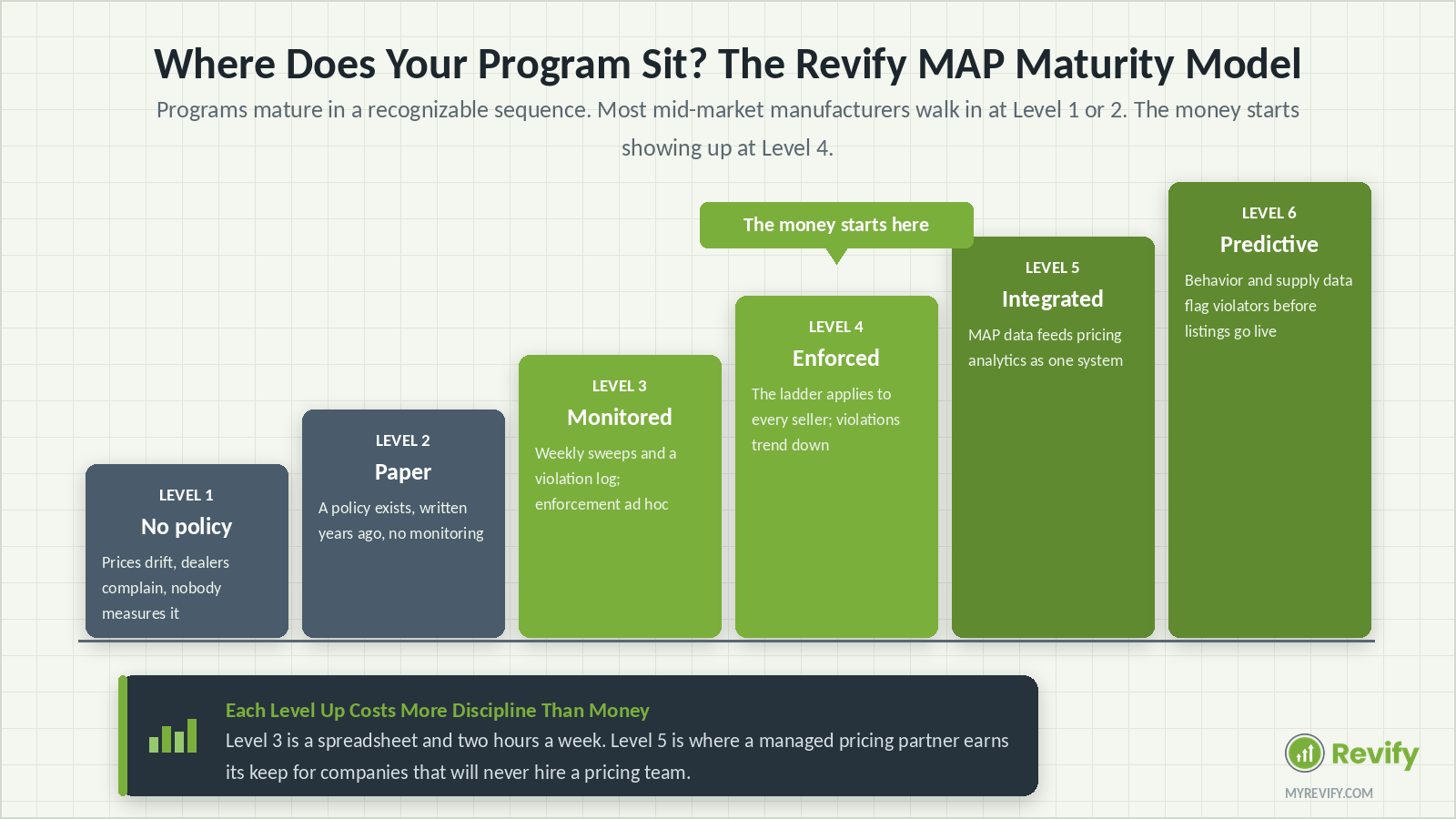
Programs mature in a recognizable sequence. We use six levels with clients; most mid-market manufacturers walk in at level 1 or 2, and the money starts showing up at level 4.
The six levelsLevel 1, no MAP policy: advertised prices drift, dealers complain, nobody measures it.Level 2, paper: a MAP policy exists, usually written years ago, with no monitoring behind it.Level 3, monitored: weekly sweeps and a violation log by seller; enforcement still ad hoc.Level 4, enforced: the ladder applies to every seller, including the big ones; violations trend down and stay down.Level 5, integrated: MAP data feeds pricing analytics, so advertised integrity, realized price, and channel margin get managed as one system.Level 6, predictive: seller behavior, repricer patterns, and supply data flag likely violators before listings go live.
Figure 8. The Revify MAP maturity model, from no policy to predictive enforcement.
Each level up costs more discipline than money. Level 3 is a spreadsheet and two hours a week. Level 5 is where a managed pricing partner earns its keep for companies that will never hire a pricing team.
Frequently asked questions
Is a minimum advertised price policy legal?
Under US federal law, a properly structured unilateral MAP policy is generally lawful: adopted unilaterally, applied to advertised rather than checkout prices, and enforced consistently. Legality still turns on the specific facts and on state law. Maryland bans minimum resale price agreements outright, California and New York scrutinize them closely, and the EU treats advertised price floors far more severely. Have antitrust counsel review your policy before rollout.
What is the difference between MAP and MSRP?
MSRP is a suggested selling price and binds no one. A MAP policy is a floor on the advertised price, backed by consequences that the manufacturer applies. A reseller can advertise at MSRP, at MAP, or anywhere above the floor, and can still sell at any price at checkout.
Does a MAP policy control the price a reseller actually charges?
No. It governs only advertised prices, and a well-drafted policy states plainly that every reseller sets its own selling prices. That distinction separates a MAP policy from resale price maintenance.
Can you enforce MAP on Amazon and other marketplaces?
Against sellers you supply, yes, through the same ladder you use everywhere else. Third-party sellers you never authorized are the hard case: the published evidence shows they barely respond to enforcement, so the working lever is supply. Trace their sourcing, tighten the tap on leaking distributors, watch for repricer-driven cascades, and use marketplace brand-protection programs where you have grounds.
Who should run MAP enforcement in a company without a pricing team?
One named owner with a weekly monitoring cadence and the authority to send notices without the sales rep’s sign-off. The workload is a few hours a week for most mid-market catalogs. If nobody inside can own it, a managed pricing service runs the monitoring, the letters, and the ladder for you.
Start Your Profit Diagnostic.If advertised prices are sliding and nobody owns the fix, Revify designs the MAP policy, runs the monitoring, and executes the enforcement cadence for manufacturers without a pricing team.
About the author
Enrico SieniCo-Founder, Revify AnalyticsEnrico Sieni has spent more than two decades leading pricing and revenue growth for manufacturers and distributors. He has built and run three pricing teams from the ground up, which is part of why he is convinced most mid-market companies do not need one of their own. At Revify Analytics he helps these companies install the discipline, governance, and seller-level tracking that turn price realization from a once-a-year surprise into a number they manage every week. He writes about the practical side of pricing: what actually moves margin, and what only sounds good in a deck.
Distributor pricing benchmarks answer the one question your ERP cannot: how does my pricing compare to other distributors my size? This guide gives mid-market distributors and manufacturers six ratios to
On July 29, 2026 the Third Circuit reversed a lower-court dismissal and revived the antitrust case against Atlantic City casino-hotels and Cendyn’s Rainmaker pricing software. Originally published on the Revify
US ports are projected to handle a record 2.47 million containers in July 2026, yet Drewry counts carriers blanking 6–8 transpacific sailings anyway, with rates up more than $3,000/FEU since