Originally published on MyRevify.com — republished here for the Pricing Lever audience.
Learn how mid-market B2B companies can build a sustainable pricing transformation capability to stop margin leakage and drive EBITDA growth.
Building a robust pricing transformation capability is essential for mid-market manufacturers and distributors looking to stop margin leakage, build pricing discipline, and create a self-funding path to sustained EBITDA growth.
Pricing transformation is one of the most discussed commercial priorities in B2B manufacturing and distribution. Yet most companies never realize its full value.
Companies analyze, hire consultants, and invest in tools, but results often fade within two quarters.
The core issue is not a lack of insight, but a lack of capability.
Many try to optimize pricing before establishing control, invest in analytics before instilling discipline, and implement tools before defining governance. This often leads to failure.
Successful companies take the opposite approach. They first build structured, governed, and repeatable pricing capabilities before pursuing optimization.
For mid-market companies without dedicated pricing teams, closing this capability gap is essential.
The Problem Pricing Transformation Actually Solves
Mid-market manufacturers and distributors operate with many SKUs, large customer bases, and constant cost pressure. Customer procurement teams grow more sophisticated each year.
However, many lack the infrastructure needed to manage this complexity.
They often lack a dedicated pricing team, a consistent process, or effective governance.
This leads to consistent outcomes: erratic decisions, slow responses, and ongoing, unnoticed margin erosion.
Most leadership teams recognize this issue, but few can quantify it or identify a clear solution.
What Pricing Looks Like Today

In most organizations, pricing is still driven by individual judgment.
Customers request better pricing, reps check previous quotes, and managers approve discounts with limited margin visibility. Inconsistent spreadsheets complicate oversight.
When this occurs across hundreds of weekly transactions, it results in both inconsistency and structural margin leakage.
The primary issue is not poor decisions but unstructured decision-making.
A big gap often exists between intended charges and realized prices after rebates and exceptions. That gap is where profit vanishes.
The Financial Impact Is Larger Than It Looks
Pricing leakage appears across discounting, inconsistent terms, freight, and execution gaps.
For a $100 million distributor at an 8 percent EBITDA margin, recovering just 1.5 points adds $1.5 million to the bottom line.
This level of impact is difficult to achieve through cost reduction or volume growth. Pricing improvements deliver rapid and significant results.
This is why pricing remains the most effective profit lever in B2B businesses, even though it is often the least structured.
Why Most Pricing Transformations Don’t Stick
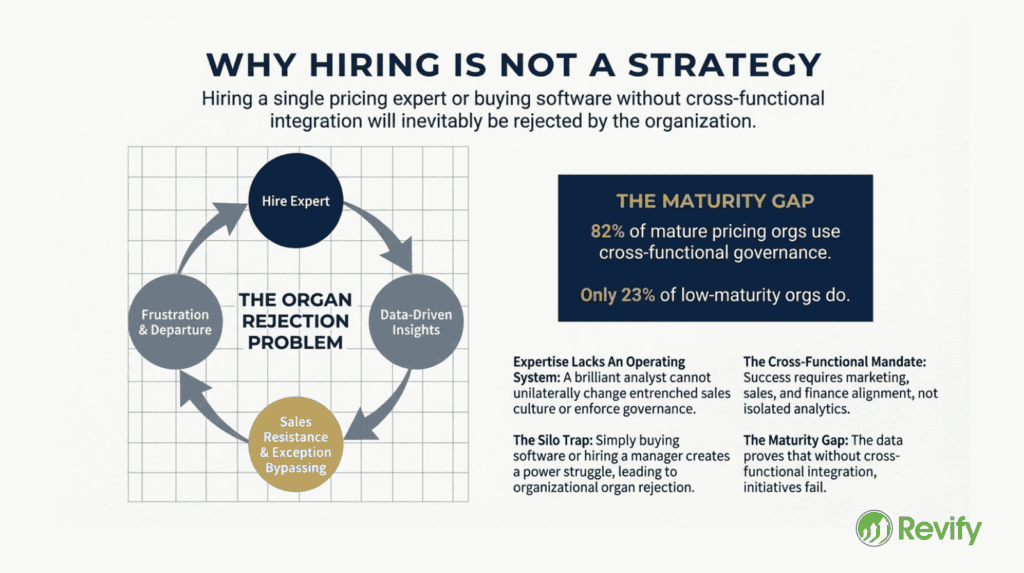
There is no shortage of analysis or frameworks in this area. Execution is almost always where failure occurs.
Companies prioritize optimization before basics, add tools without changing habits, and ignore the human factor in pricing.
Sales teams maintain existing habits, exceptions persist, and governance remains undefined or overlooked. As a result, initial gains gradually erode.
Pricing is often treated as a project rather than an ongoing operating discipline, leading to breakdowns.
What Actually Changes When You Build Capability

Effective pricing results from consistent decision-making, not simply from improved models.
Discounts are granted within defined boundaries, exceptions are visible and controlled, and pricing decisions follow established processes rather than individual preferences.
This shift relies on three elements working together.
First, discipline. Clear rules on discount authority, pricing floors, and exception handling.
Second, governance. A defined operating rhythm where pricing performance is reviewed regularly, and accountability is clear.
Third, execution infrastructure. Workflows and support mechanisms ensure pricing decisions are made consistently in real time.
Most mid-market companies struggle to implement these changes because of limited internal resources.
The Missing Piece Is Not Software
Although some companies also struggle with poor data and key pricing metrics, most organizations lack a functioning pricing capability.
They require expertise to interpret current performance, define necessary changes, and ensure those changes are sustained.
The most effective approach is to build awareness and price management capabilities rather than simply adding tools.
This is where the combination of people, process, and platform matters.
Experienced pricing professionals provide direction and prioritization. Structured processes create consistency and control. Purpose-built analytics support decisions and track outcomes.
The result is a fundamentally different way of operating, not just more reporting.
A Practical Path to Building Pricing Capability
Pricing capability develops in stages, and the order of implementation is important.
The first step is to understand where margin is being lost and the size of the opportunity. This requires a structured diagnostic that examines transaction data, discount patterns, and profitability across customers and products.
This process reveals high-impact opportunities, often tracing most leakage to a few customers, products, or behaviors.
Once those opportunities are clear, the next step is to stabilize pricing by establishing discipline and governance.
Discount guardrails are established, approval workflows are implemented, and pricing decisions become more transparent. The objective at this stage is control rather than optimization.
This is typically where companies first see meaningful margin improvement.
Optimization is effective only after this foundation is established. Segmentation, value-based pricing, and advanced methods deliver value once the system is stable.
What This Looks Like in the First 90 Days
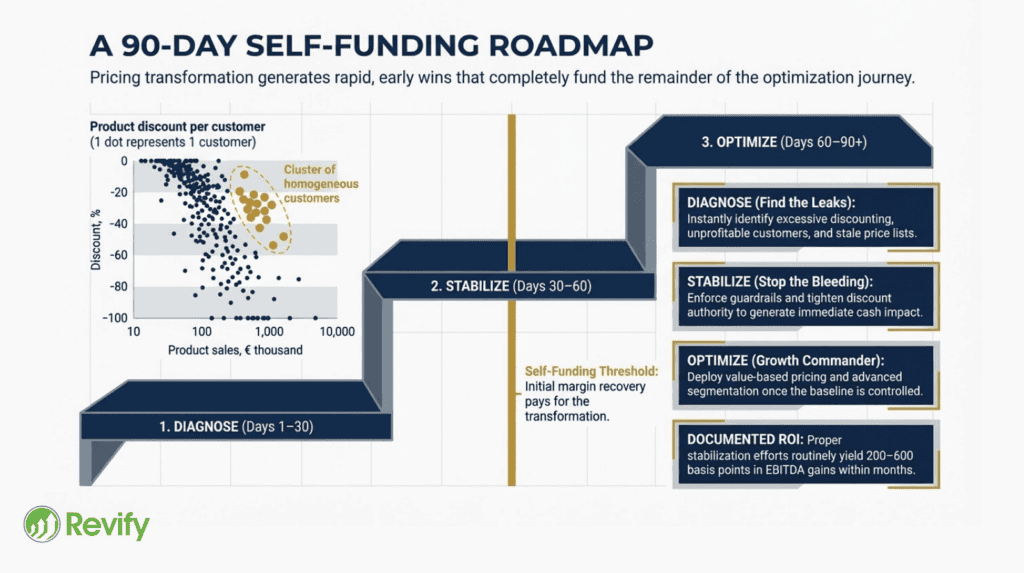
Many believe pricing transformation takes a year to yield results, but significant gains often occur early.
The initial weeks focus on obtaining accurate data and identifying areas of concentrated leakage, often revealing several immediate solutions.
Within the first month, companies can tighten discount authority and address outliers. Pricing errors, inconsistent terms, and gaps are often corrected quickly.
By the second month, additional structure is established. Approval workflows are defined, pricing decisions become more consistent, and sales teams operate within clear boundaries.
By the third month, a basic operating rhythm is established. Pricing performance is reviewed regularly, and adjustments are made proactively.
At this stage, pricing operates as a controlled system rather than a collection of individual decisions.
Although this process can be daunting, Revify Analytics provides the building blocks to help you succeed. Get started with a preliminary diagnostic in days and see transparent, affordable pricing. Take your first step toward sustained margin improvement—visit MyRevify.com today.
What the Impact Looks Like in Practice
Across mid-market companies, these patterns are consistent.
Discount variability decreases when guardrails are enforced, and margins improve by eliminating significant leakage. Aligning freight and surcharges often recovers substantial value.
Commercial teams begin to identify previously overlooked opportunities. Cross-sell gaps become apparent, customer-level profitability is clarified, and decisions become more focused.
For private equity-backed businesses, these changes often result in measurable EBITDA improvement within a short timeframe, making pricing a priority early in the investment period.
measurable EBITDA improvement within a short timeframe, making pricing a priority early in the investment period.
Where the Quick Wins Usually Are
The most impactful improvements are usually straightforward.
These improvements often come from tightening discount authority where it is most frequently exceeded, correcting pricing inconsistencies on high-volume items, aligning surcharges with actual costs, and consistently enforcing existing policies.
Companies that prioritize these areas usually progress more quickly and build momentum.
How to Measure Whether It’s Working
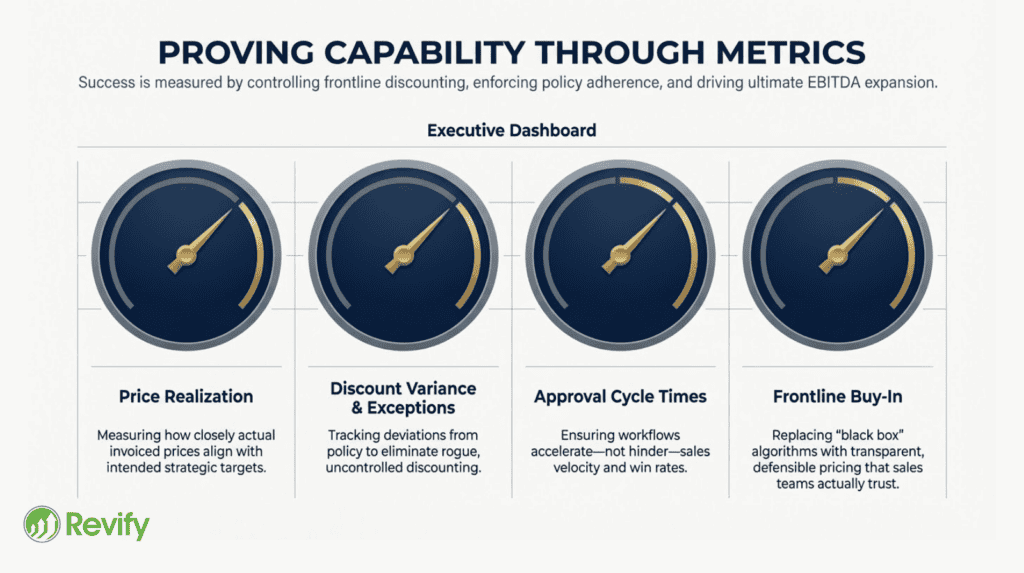
Pricing transformation should be monitored using a few clear metrics.
Price realization measures how closely actual prices align with intended levels. Discount variance identifies deviations from policy, and exception rates show the extent of pricing outside defined rules.
Ultimately, the most important metric is whether these changes lead to EBITDA improvement.
Regular review of these metrics is essential. Quarterly reviews are often not frequent enough to make timely corrections.
Getting Started
Most companies do not require significant upfront investment to begin; they need clarity.
A structured diagnostic usually identifies the scale of the opportunity and the most impactful actions. Often, initial changes quickly offset their own costs.
Revify Analytics is ready to help you begin your journey toward pricing improvement and increased profitability. Contact us now to start capturing missed margin and driving results.
This self-funding aspect distinguishes pricing transformation from many other initiatives.
The greatest challenge is not the analysis but the decision to transition from reactive pricing to a managed system.
FAQs
What is a pricing transformation capability?
It’s the shift from reactive, inconsistent pricing decisions to a structured, governed approach that improves margin and consistency across the business.
How long does it take to see results?
Building a fully mature pricing transformation capability takes longer, but early gains typically come quickly.
Do you need pricing software to start?
No. Most companies need discipline and governance before they need advanced tools. Technology becomes more valuable once the underlying process is in place.
What pricing strategies matter most?
Cost-plus, competitive, value-based, and dynamic pricing are all relevant. In practice, companies tend to use a mix, with stronger results coming when pricing is aligned with customer value and supported by consistent execution.
What are the key inputs to pricing decisions?
Customers, costs, competitors, the company’s own objectives, and the channels through which products are sold all play a role. The challenge is not identifying these factors—it’s applying them consistently.
Start Building Your Pricing Transformation Capability
Most companies already have significant opportunities within their businesses; what is lacking is the structure to capture them.
The first step is to identify where margin is being lost and determine practical solutions.
From this point, pricing transitions from a reactive process to one that can be actively managed.