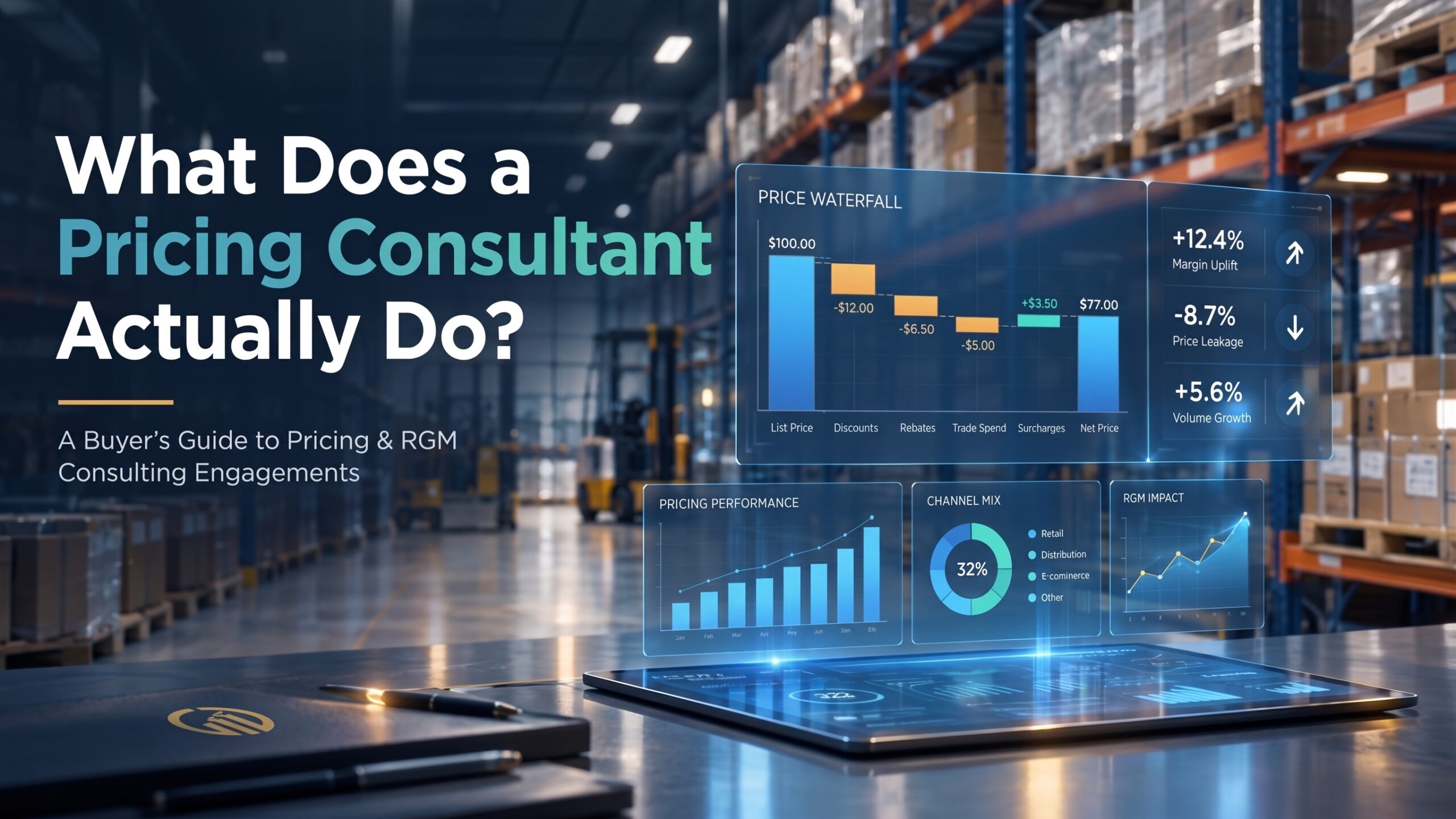
A practical guide for mid-market manufacturers and distributors seeking sustainable margin improvement without hiring a dedicated pricing team.
Most mid-market manufacturers and distributors lack a head of pricing, a deal desk, or a single owner for discount governance, yet still require the margin improvements these roles deliver. This gap is often why a revenue management solutions company is engaged. The key challenge is ensuring these engagements are effective. Software and dashboards accelerate progress but do not replace the necessary work. This guide explains how to implement pricing excellence without a dedicated pricing team, using Revify’s engagement model as a practical example.
Why mid-market manufacturers struggle with revenue management
Revenue Growth Management (RGM) has been a board-level priority for over a decade. However, most mid-market manufacturers and distributors still manage pricing through spreadsheets and intuition. Data is less structured than in CPG, deal cycles are slower, and dedicated ownership is uncommon. As a result, margin losses often occur before they are detected in quarterly reports, prompting leaders to seek support from a revenue management solutions company.
Margin leakage from inconsistent pricing decisions
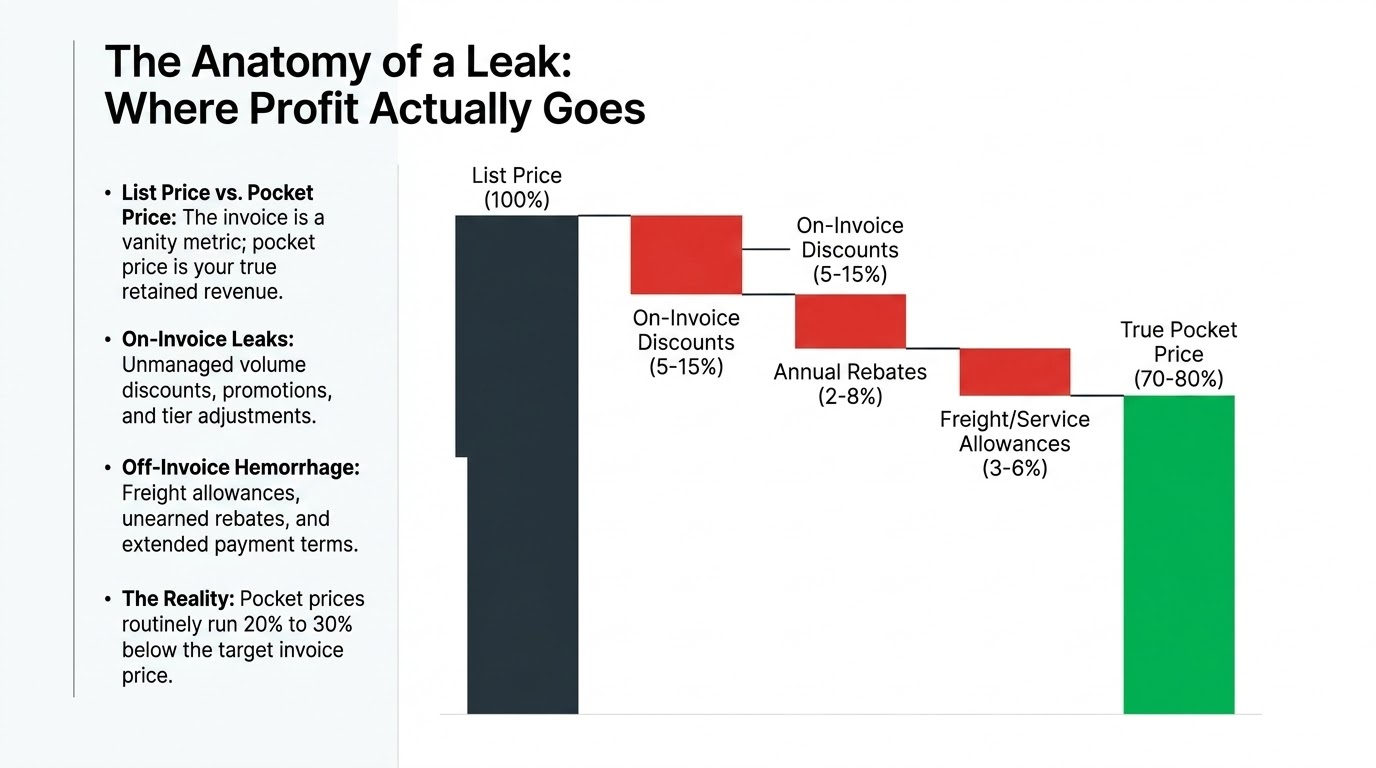
Margin leakage rarely results from a single poor decision. Instead, it stems from numerous small concessions, such as unmanaged goodwill discounts, unearned volume rebates, outdated list prices, and unauthorized freight allowances. Industry data shows that about 51% of companies lack even a basic price waterfall, which is essential for tracking revenue from list to pocket. Without this visibility, leakage accumulates unnoticed and becomes part of standard operations.
The cost of relying on sales-led exceptions
When sales teams implicitly control pricing, exceptions become standard practice. Pre-program discount exception rates of 40–60% are common in B2B distribution and manufacturing, as documented by the Professional Pricing Society. While each exception may seem justified individually, collectively they encourage customers to negotiate, prompt sales representatives to offer discounts first, and reduce price realization before it is recognized.
Tribal pricing behavior and branch autonomy
A unique cultural pattern in mid-market distribution and manufacturing is that pricing decisions are often made locally. Branch managers set prices differently from headquarters, and long-tenured representatives manage their own accounts. Discount history is often undocumented. Any pricing operating model that overlooks this dynamic is likely to fail, not due to flawed analytics, but because it does not address the underlying authority structure.
The financial case — pricing as the highest-leverage commercial lever
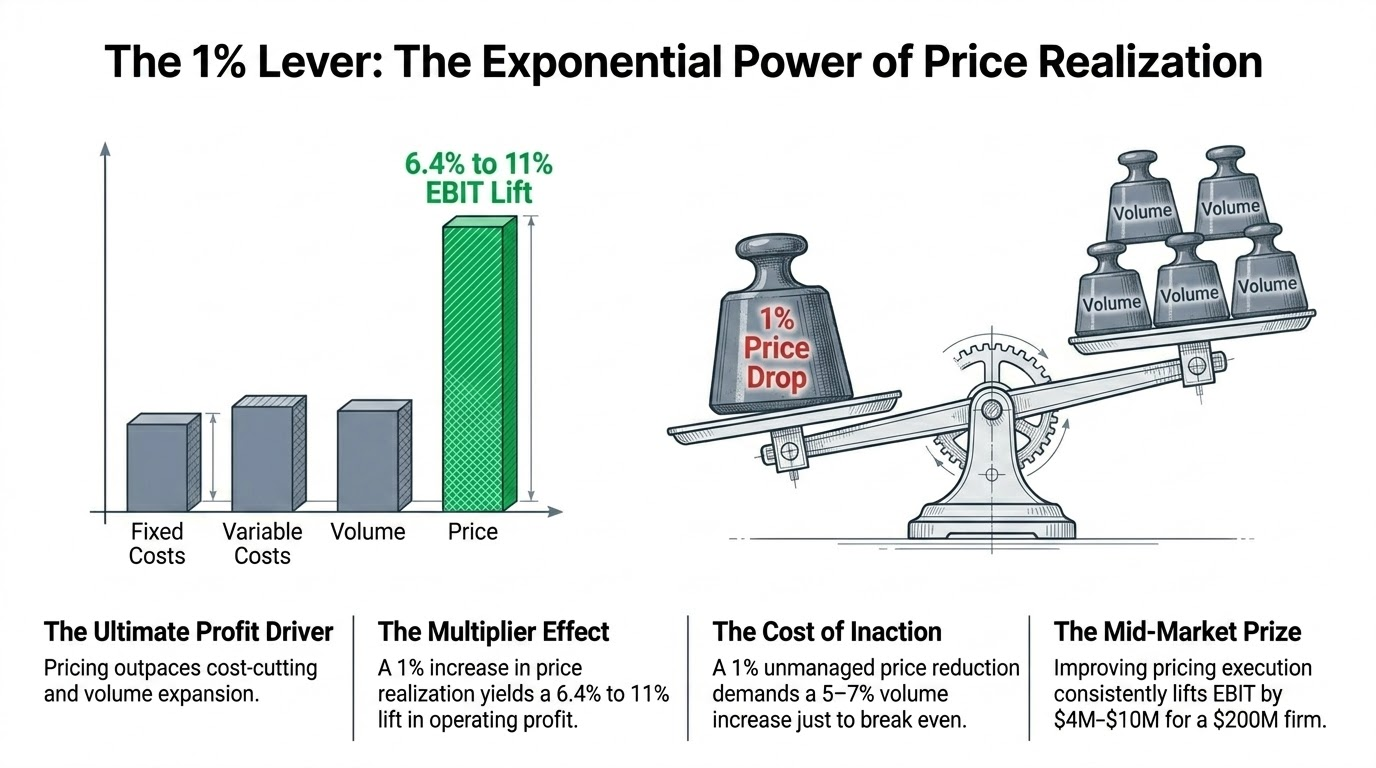
Executives typically understand the importance of pricing but require a clear financial impact. For a distributor with a 20% gross margin, a 1% price reduction necessitates a 5–7% increase in volume to maintain gross profit. Conversely, a 1% price increase, with volume held constant, can raise operating profit by 6–11%. According to Revology Analytics’ research of 2,000 global companies (“Pricing Still Packs a Punch,” June 2025), the average improvement is 6–7% across industries and 10–11% outside highly regulated sectors.
Consistent research shows that leading pricing organizations achieve 200–500 basis points of margin uplift in distribution. No other commercial lever delivers comparable results, supporting the case for treating pricing as a managed capability rather than a sales-driven decision.
What a revenue management solutions company should actually change
The key question is not which software-first RGM platform to purchase, but rather what operating model is required before any platform can be effective. A capable pricing partner begins with this foundation.
From one-off recommendations to pricing capability
Most consulting recommendations are not implemented because they provide insights without clear ownership. Pricing should be viewed as a capability, not a one-time project, and initiatives positioned as simple handoffs with a promised ROI often fail to last. A modern revenue management solutions company should be evaluated on whether the client has an effective pricing capability at the end of the engagement, not on the volume of deliverables. Capability includes defined decision rights, guardrails, regular routines, and clear accountability, which should be the primary outcome of any engagement.
Governance & control across approvals, discounts, and deal terms
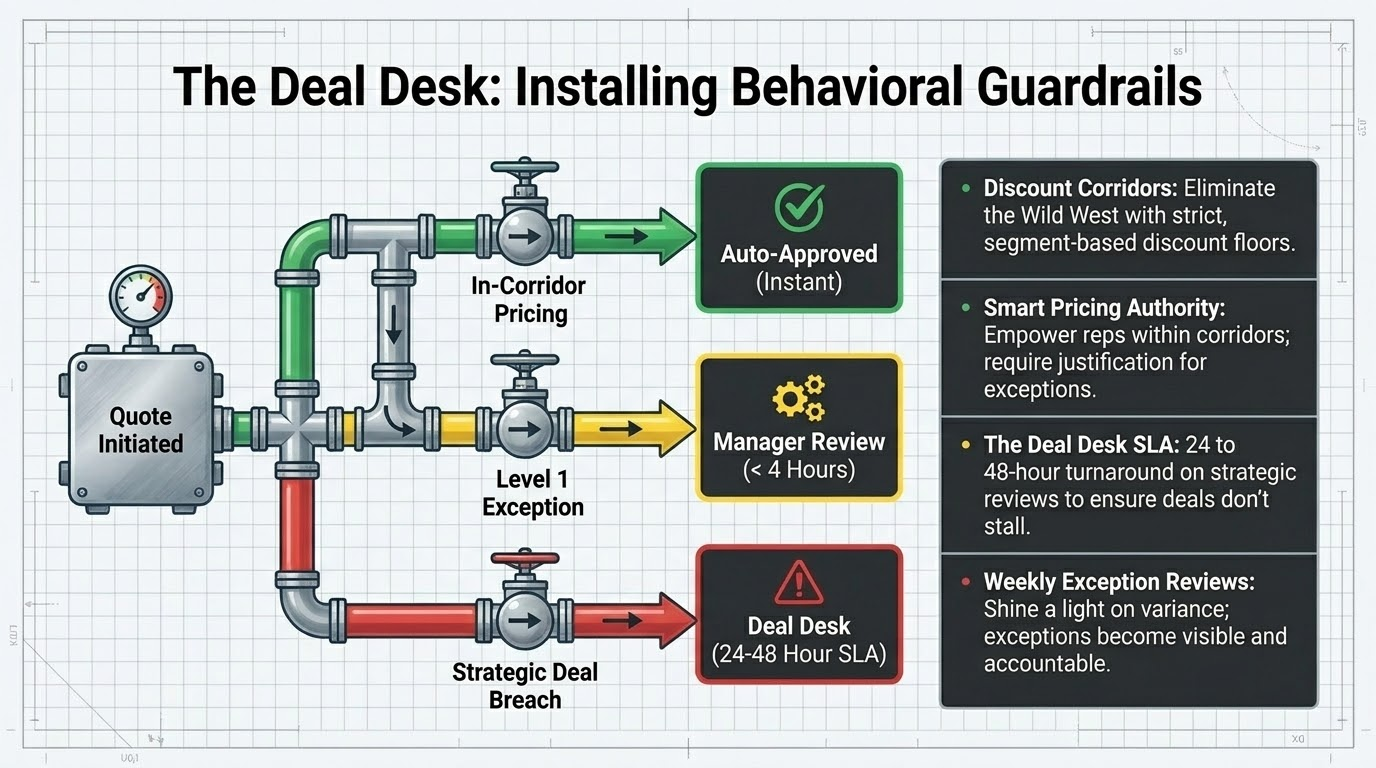
Governance, while often overlooked, is essential for effective pricing management. Implementing a clear discount matrix by segment, two-stage approvals for deals exceeding set thresholds, and monthly exception reviews typically reduce exception rates within 90 days. These measures do not require an RGM platform but do require documented rules, assigned owners, and a structured schedule.
Why blanket price increases usually fail
Following a margin decline, the common response is to implement a uniform 3% list-price increase. However, this approach often damages customer relationships without achieving significant margin recovery. Customer elasticity, willingness to pay, and competitive dynamics vary widely across segments and SKUs. Applying a uniform strategy overlooks these differences and misses the pricing opportunities a revenue management solutions company should address.
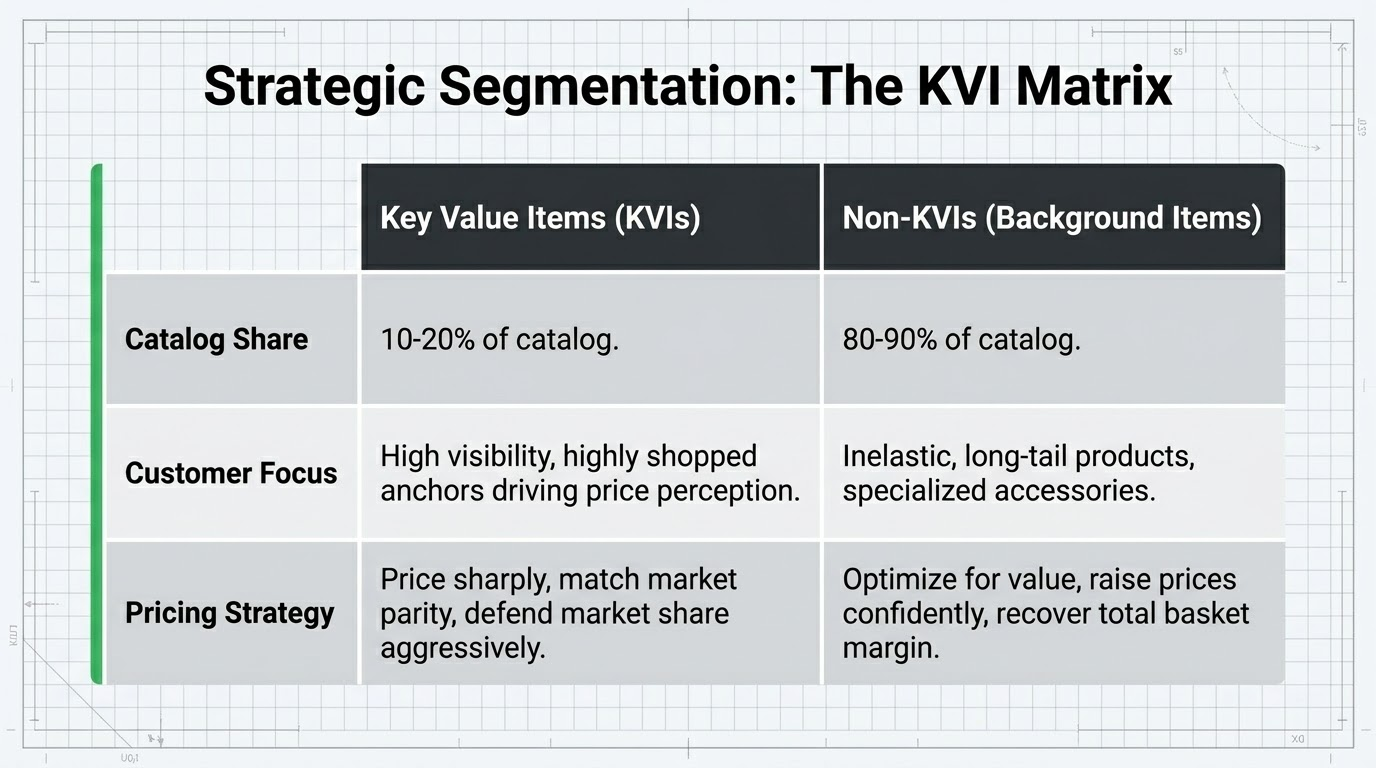
Distributor research demonstrates that price is the primary factor for key value items (KVIs), which are typically the top 20% of products that customers actively compare. For the remaining 80%, customers are less price-sensitive, presenting the best opportunities for margin recovery. An effective pricing partner establishes clear guidelines that distinguish between defending share on KVIs and optimizing value on non-KVIs, supported by strategic price customization at the account level.
This involves segmenting customers by behavior, classifying SKUs into KVI and non-KVI categories, setting guidelines for each segment-SKU combination, and equipping sales representatives with value-based communication. Blanket price increases bypass these steps and often result in customer attrition.
How pricing works differently with a virtual pricing team
When hiring a dedicated team is not feasible, a virtual pricing team offers a practical alternative. This model combines experienced pricing leaders, structured processes, and tailored analytics with the client’s commercial team. It functions as a fractional pricing department, providing the same authority structure as a fully staffed team without increasing headcount.
Clear ownership for pricing decisions
Each pricing decision should have a clearly assigned owner. In a virtual model, the revenue management solutions company acts as the primary pricing function, managing list-price logic, discount policies, exception escalation, and quarterly price reviews. The client maintains final authority over complex accounts, while the team ensures decisions are informed, consistent, and well-documented.
Deal desk workflows that support sales without giving away margin
A deal desk is effective when sales teams follow established processes. This requires three key elements. First, approval thresholds must be explicit; for example, discounts within set limits are approved by representatives, those 5–10% above list require manager approval with written justification, and larger exceptions escalate to the pricing council. Second, response-time service level agreements should be enforced, typically 24 hours for standard deals and 4–8 hours for strategic accounts.
Third, escalation procedures must be clear, with designated owners at each level. Zilliant’s analysis shows that manual, spreadsheet-driven pricing processes are three to five times slower than structured workflows, leading to delays that can result in lost deals and margin.
Operating cadence that holds the discipline together
A consistent operating cadence is essential. In mid-market organizations, this typically includes a weekly KPI review (covering price realization, exception rate, and quote turnaround), a monthly exception governance meeting to address breaches, a quarterly pricing council to update the discount matrix, and an annual list-price review. Each meeting should have a written agenda, an assigned owner, and documented decisions. Without this structure, governance documents are often ignored.
Pricing discipline that sticks after rollout
Most pricing initiatives lose momentum within 90 days of launch, as new behaviors have not yet become routine and upcoming deals often revert to previous practices. A virtual pricing team provides ongoing support that software-only solutions cannot, by managing the operating cadence, updating data, retraining sales representatives, and maintaining discipline beyond the initial project period.
Why pricing governance fails without sales compensation alignment
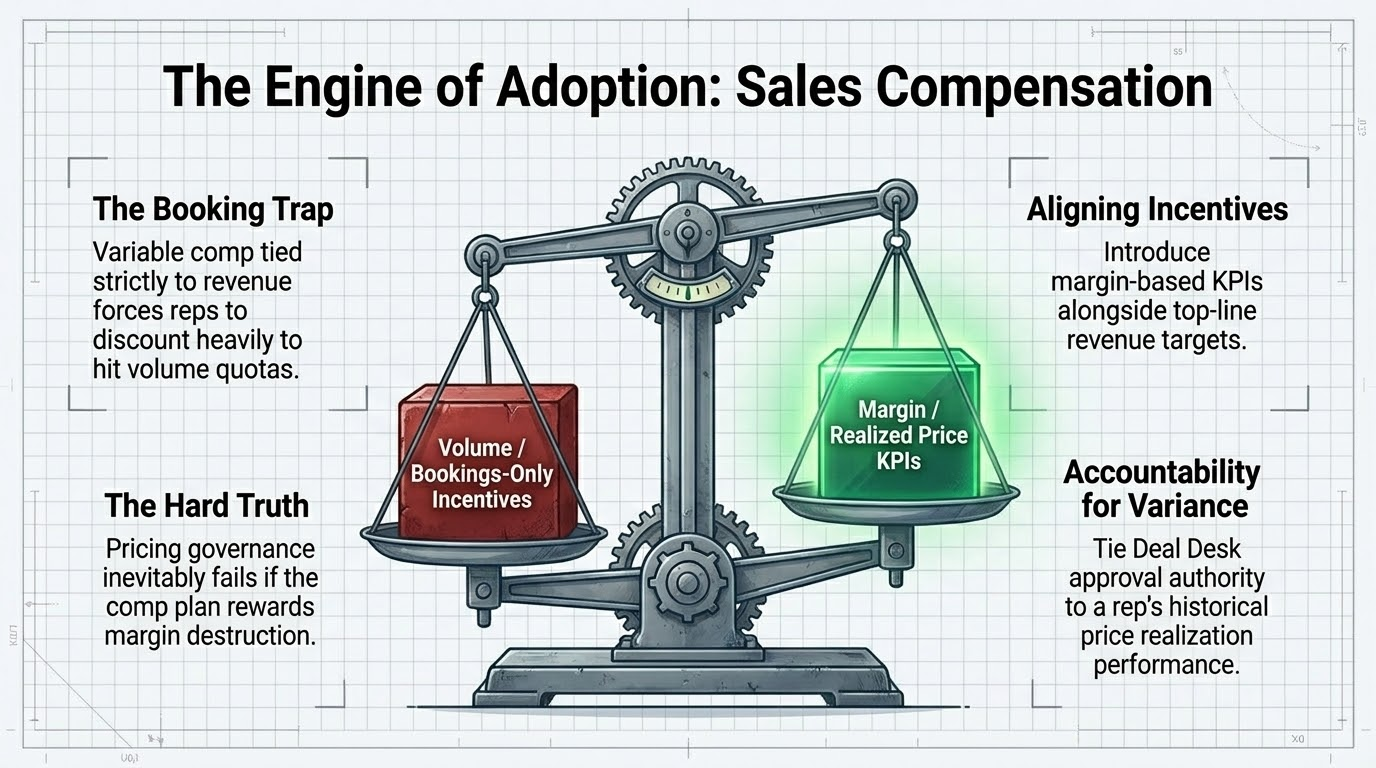
Even well-designed governance can fail if the sales compensation plan rewards only bookings. When variable compensation is based solely on revenue, representatives will prioritize volume over margin whenever possible. No discount matrix can withstand this incentive structure, regardless of the revenue management solutions company involved.
Pricing research confirms that even the best pricing strategies can fail if incentives are misaligned. Since sales teams typically manage quoting, their incentives must align with the pricing model. Solutions include introducing margin-based KPIs alongside revenue, publishing price realization by representative each month, linking exception-approval authority to a representative’s twelve-month margin performance, and adjusting variable compensation to include revenue, gross profit, and strategic account growth. Implementing a pricing operating model without addressing incentives leaves it incomplete.
Revify’s described framework can be implemented in various ways.
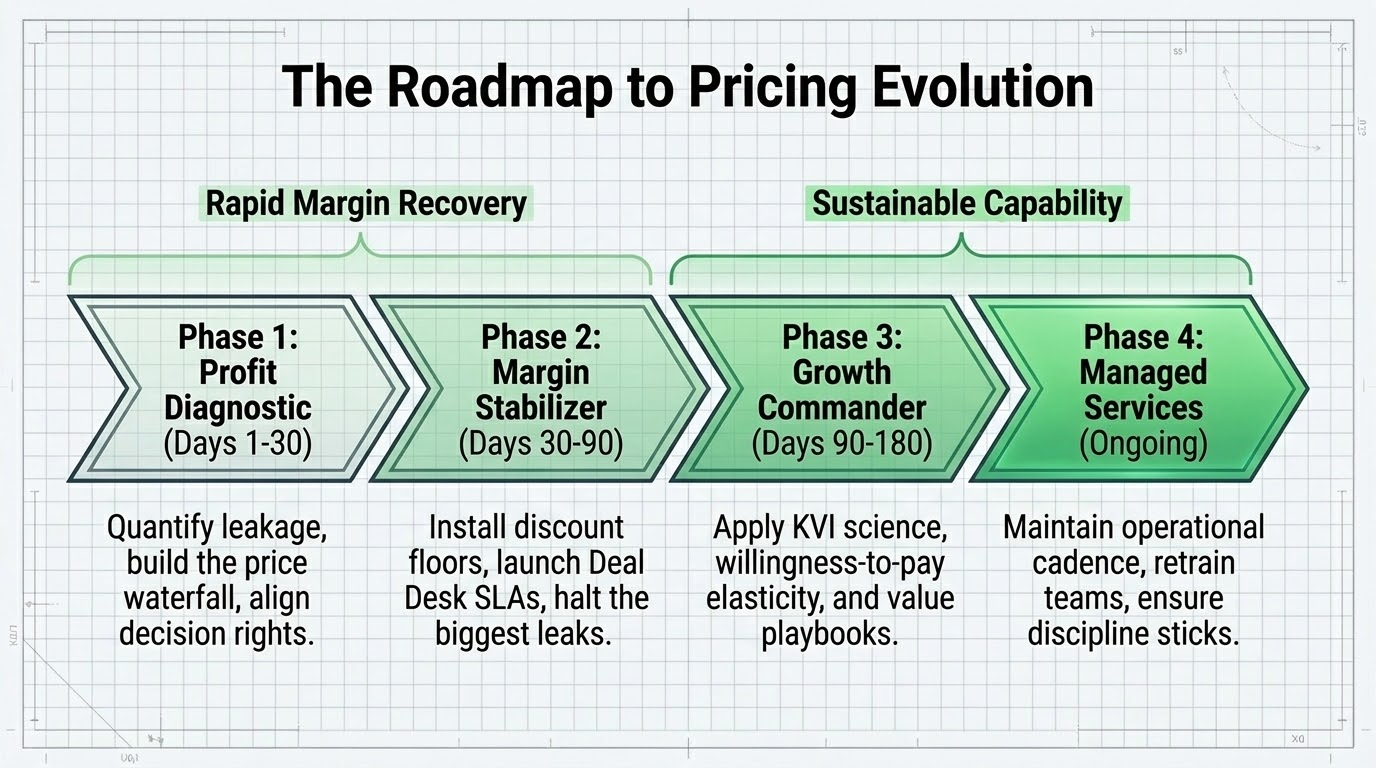
Revify’s approach is phased, with clear entry criteria, deliverables, and KPIs at each stage. The four phases—Profit Diagnostic, Margin Stabilizer, Growth Commander, and Managed Services—represent the practical sequence a revenue management solutions company follows when it retains execution authority. The execution authority sits inside the engagement.
Profit Diagnostic — find leakage and prioritize action
This four-week phase quantifies margin leakage, estimates potential gains, and develops a 90-day action plan. The diagnostic focuses on identifying the three to five highest-impact opportunities, rather than an exhaustive list. Deliverables include a leakage map, a prioritized opportunity list, and a draft decision-rights matrix.
Margin Stabilizer — install guardrails and stop erosion
This phase converts diagnostic findings into operational discipline by implementing a discount matrix, two-stage approval thresholds, monthly exception governance, and a deal desk service level agreement. The goal is to halt margin erosion before beginning optimization.
Growth Commander — improve realization and account actions
This phase rebuilds the segment-level price matrix, implements customer-level pricing, and equips the sales team with value-based playbooks. At this stage, KVI and non-KVI pricing logic is implemented, and margin improvement typically accelerates.
Mini case — anonymized mid-market med-tech manufacturer
Initial state: List pricing was managed centrally, but 47% of deals included sales-driven discount exceptions. There was no deal desk, margin reporting occurred only at quarterly close, and no dedicated pricing function existed. Approvals were informal, typically requiring VP input, and sales compensation rewarded bookings without a margin threshold.
Intervention: The diagnostic identified approximately $3.2 million in annualized leakage, primarily in three customer segments. The team implemented three guardrails: a segment-level discount matrix, two-stage approval for discounts above 8%, and monthly exception governance. A deal desk with a 24-hour service level agreement was established. During optimization, the segment-level price matrix was rebuilt, and a value-based sales playbook was introduced.
Resistance and result. Two regional sales leaders pushed back hard in months one and two; the CFO held the line, partly because the diagnostic had quantified the leakage in CFO-readable dollars. Over twelve months: exception rate fell from 47% to 11%, net price realization improved by roughly five points, EBITDA lift of approximately $2.6M — delivered without hiring a dedicated pricing team. The adoption held because compensation and approval rights were addressed in parallel, not after.
You do not need perfect data to start.
A common reason mid-market pricing transformations never get started is the assumption that the data must be cleaned first. In practice, it never is — and waiting for it is the most expensive form of inaction. Most mid-market ERPs carry inconsistent customer IDs, partial freight allocation, missing rebate logic, and no clean cost-to-serve view. None of that prevents progress. The right early move is good-enough analytics on the cleanest 70–80% of the transactional history, paired with a parallel data hygiene workstream. The drivers behind revenue and profit performance usually come into focus within the first 30 days, even with imperfect data, and the diagnostic itself surfaces the gaps worth fixing first.
Quick wins and expected timeline
The biggest mistake mid-market leaders make is waiting for a “complete” pricing transformation before acting. A capable pricing partner delivers measurable wins inside the first quarter.
First 30 days — identify leakage and align decision rights
In the first month, the diagnostic produces three deliverables: a quantified leakage map, a prioritized opportunity list, and a draft decision-rights matrix that assigns an owner to each type of pricing call. None of these requires a platform. All of them survive a change in leadership.
First 60–90 days — launch controls and execution routines
By day 90, guardrails are live, the deal desk is operational, the exception review has been chaired at least twice, and sales has seen its first round of coaching from real deal data. The KPI dashboard reports price realization and exception rate weekly. At that point, the revenue management solutions company has earned the right to discuss optimization.
KPIs that show pricing confidence are improving.
Two metrics matter more than the rest in the first 180 days; six others matter once the basics are in place. Track them weekly in the early phase.
Price realization
Price realization is the percentage of the list price that actually reaches the bottom line.
Price Realization (%) = (Net Realized Price ÷ List Price) × 100
where Net Realized Price = List Price − discounts − rebates − allowances − chargebacks.
It is the single most diagnostic pricing KPI because it captures every off-invoice and on-invoice concession in one number. Realization gains compound: an improvement of 2 to 3 points typically translates to a high-teens percent operating profit lift in mid-market manufacturing.
Discount control and exception rates
Discount Exception Rate is the simplest and most diagnostic of governance KPIs.
Discount Exception Rate (%) = (Deals priced outside guardrails ÷ Total deals in period) × 100
A healthy mid-market target after 90 days of governance is below 15%; pre-program rates of 40–60% are common. The trajectory matters more than the absolute number; anything sitting above 30% after six months indicates the guardrails are decorative.
Pocket margin, mix-adjusted realization, and quote turnaround
Pocket margin — the margin remaining after every concession, including freight, rebates, returns, and customer-specific service costs — is the truest profitability measure at the deal level. Mix-adjusted price realization separates pricing performance from pure mix shifts when composition is changing quarter over quarter. Quote turnaround time (median and 90th percentile) reveals deal-desk bottlenecks and cases where reps are routing around governance because the process is too slow.
Win-rate by price band, margin by rep, and customer-level signals
Win-rate by price band reveals where price sensitivity actually lies — often showing that the assumed price ceiling is several points above the floor sales have been defending. Margin by rep, published monthly, surfaces top performers and reps whose volume hides systematic margin erosion. Customer-level margin diagnostics decompose lift by segment, product, and rep, and pair pricing actions with churn risk so retention offers do not silently destroy more value than the revenue they save.
Why most pricing transformations stall after 90 days
The honest answer is rarely “the analytics were wrong.” The patterns that stall pricing transformations are organizational and predictable enough to plan against.
The common failure modes are shadow discounting (reps work around the deal desk through handshake side terms), executive override culture (one off-policy CEO approval and the precedent metastasizes), inconsistent enforcement across regions or product lines, a slide in cadence as the team gets pulled into other priorities, and the “we’ll lose the customer” psychology that turns every guardrail into a negotiation with the customer-facing team rather than a constraint on their behavior.
These yield to a combination of executive sponsorship that holds the line in months one through three, transparent reporting that makes shadow discounting visible, compensation alignment that removes the incentive to route around governance, and a persistent cadence that does not depend on a single champion staying interested. A revenue management solutions company that ignores any of these dimensions is implementing software, not building a pricing function.
How operating models compare structurally
Mid-market leaders typically choose between five operating models when selecting a revenue management solutions company. Each has a structural strength and a structural failure mode.
Pure consulting. Strong on diagnosis and strategy. Weak on operational persistence — gains erode once the engagement ends because no one chairs the cadence on day 91.
Pure software (RGM platform). Strong on data unification. Weak on governance adoption — without an operating model, the platform institutionalizes the existing dysfunction at higher fidelity.
Internal-only build. Strong on cultural fit and long-term ownership. Weak on expertise and capacity — most mid-market firms cannot recruit and retain the depth of pricing leadership needed in a reasonable timeframe.
Outsourced analytics. Strong on reporting depth. Weak on execution authority — analysts produce insight but do not own the discount matrix or chair the exception meeting.
Virtual pricing team. Combines analytics, governance, and execution cadence under one accountable structure with embedded leadership that the client can rely on day one. The structural weakness is dependency risk if managed services persist indefinitely without transferring capability, which is why a healthy engagement plan is for a phased reduction in external authority as internal ownership matures.
How to evaluate revenue management, partners
Not every revenue management solutions company is built to deliver. Mid-market manufacturers and distributors should pressure-test partners on a few specific questions before signing.
Questions to ask beyond software or reporting
Ask what the first 30 days look like — and demand specifics, not pillars. Ask how the partner handles organizational pushback when guardrails reduce a top rep’s discount authority. Ask which named clients they have moved from a 40%+ exception rate to under 15%. Ask how the comp plan changes as the pricing rollout progresses. The answers separate execution partners from deck shops.
Signs a partner can execute, not just advise
A capable partner brings pricing leadership the client can borrow on day one, references a working deal desk in a comparable industry, and discusses governance, cadence, and change management before showing the analytics. Partners who lead with the platform demo usually fail the adoption test.
FAQ
What does a revenue management solutions company do?
A revenue management solutions company helps a business price more deliberately and capture margin already earned — through diagnosis, governance, optimization, and ongoing execution. The best approach is to build internal capability rather than create a dependency.
How is revenue management different from pricing capability building?
Revenue management is the discipline; pricing capability building installs that discipline within a specific organization — decision rights, a deal desk, a governance calendar, and analytics routines that run every week.
Can we improve the margin without hiring a full pricing team?
Yes. A virtual pricing team — borrowed leadership, embedded processes, managed-service execution — combined with a phased engagement that installs governance before optimization is the standard mid-market path.
What should happen first — diagnostic, governance, or optimization?
Diagnostic first. Without a quantified leakage map, governance is generic, and optimization is premature. Governance follows in 30–60 days; optimization comes once the guardrails are in place.
How long does it take to improve price realization?
Visible gains usually appear in 90–120 days, with the bulk landing between months four and nine. Twelve-month outcomes of two to five points are typical for engagements that pair governance with compensation alignment.
Getting started with a Profit Diagnostic
The diagnostic is intentionally low-friction. Four weeks. Data the client already has. A quantified action plan as the deliverable — not another deck.
What Revify reviews first
Twelve to eighteen months of transactional data, the current discount and approval policy (written or implicit), customer and product margin distributions, and the deal-desk workflow, if one exists. The output is a leakage map, a prioritized opportunity list, and a draft governance design — enough to make the first 90 days operational.
What your team needs to prepare
A transactional data extract, two hours of CFO/COO time, and access to two or three sales leaders. Revify handles the rest. Start Your Profit Diagnostic.
About the Author
Enrico Sieni is the founder of Revify Analytics. He has spent two decades building and operating pricing functions for mid-market manufacturers and distributors.
Distributor pricing benchmarks answer the one question your ERP cannot: how does my pricing compare to other distributors my size? This guide gives mid-market distributors and manufacturers six ratios to
On July 29, 2026 the Third Circuit reversed a lower-court dismissal and revived the antitrust case against Atlantic City casino-hotels and Cendyn’s Rainmaker pricing software. Originally published on the Revify
US ports are projected to handle a record 2.47 million containers in July 2026, yet Drewry counts carriers blanking 6–8 transpacific sailings anyway, with rates up more than $3,000/FEU since

 Pricing research confirms that even the best pricing strategies can fail if incentives are misaligned. Since sales teams typically manage quoting, their incentives must align with the pricing model. Solutions include introducing margin-based KPIs alongside revenue, publishing price realization by representative each month, linking exception-approval authority to a representative’s twelve-month margin performance, and adjusting variable compensation to include revenue, gross profit, and strategic account growth. Implementing a pricing operating model without addressing incentives leaves it incomplete.