
Originally published on MyRevify.com — republished here for the Pricing Lever audience.
A manufacturer legacy discount stack was replaced with a data-driven metal-tier pricing architecture governed by RFM and price elasticity.
Overview: Pricing Architecture Redesign
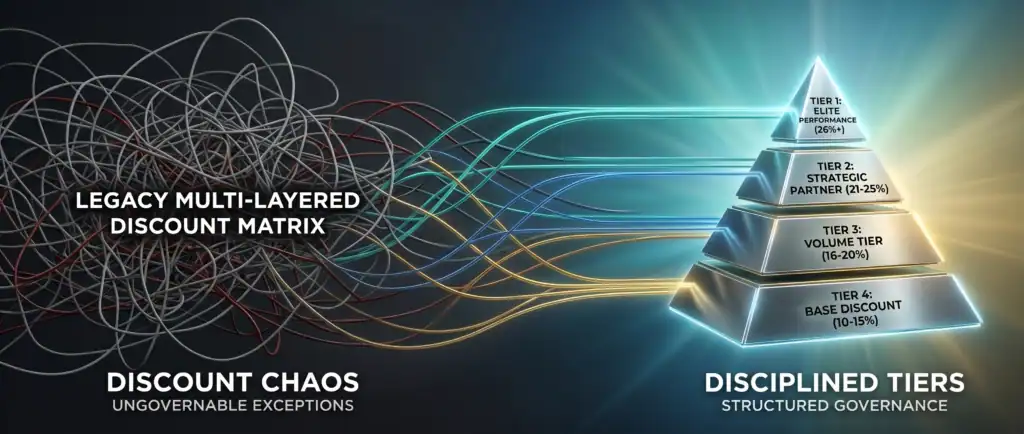
This case study shows how a data-driven pricing architecture replaced a manufacturer legacy discount stack with a clean, governable metal-tier structure — and aligned every customer to their pricing architecture tier using RFM segmentation and price elasticity. The old pricing architecture had grown organically into thousands of unused discount combinations; the new pricing architecture collapsed them into a transparent Bronze-Silver-Gold-Platinum hierarchy with a single strategic discount per customer. The result is a self-correcting system where tiers are earned by buying behavior, not legacy relationships. See the full case study below, or read our related case study on Reclaiming $1.7MM in Lost Price Realization.
Client Situation
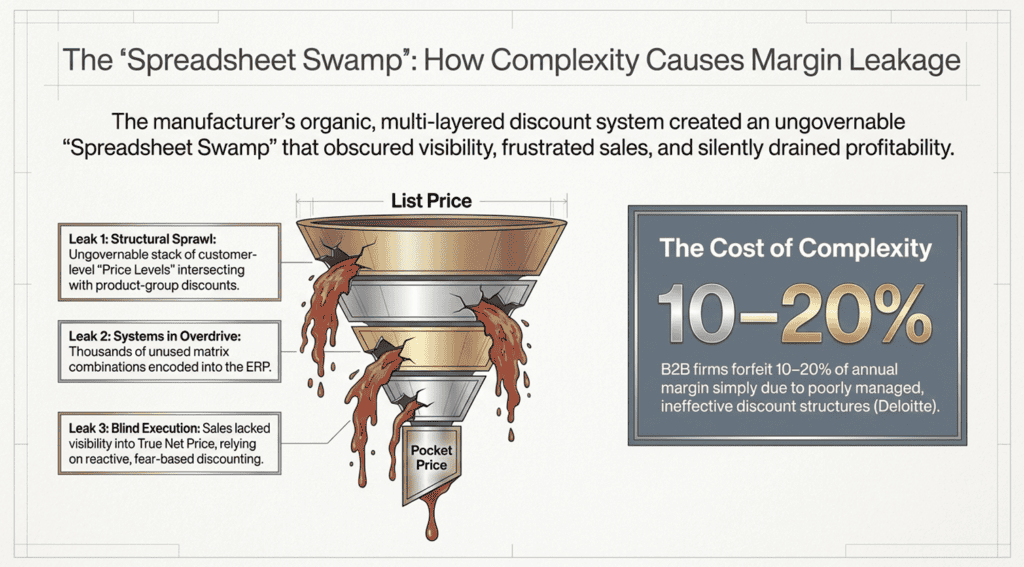
The manufacturer’s pricing was managed through a complex combination of customer-level ‘Price Levels’ stacked on top of product-group-specific discounts — a multi-layered system that had grown organically over the years and become impossible to govern.
Analysis of the actual sales mix showed that the full matrix of possible discount combinations was largely unused: sales concentrated at habitual discount anchors (e.g., 30%, 25%, 20%, 15%) regardless of the customer’s real buying power.
Redundant tiers existed for identical economic outcomes (e.g., ‘20%’ and ‘Gold’; ‘30%’ and ‘Platinum’), and the discount hierarchy no longer reflected customer behavior or strategic value.
The Revify Approach
Audit — Expose the Real Discount Behavior
- Built a sales-mix map of customer × product-group discount intersections to visualize where sales concentrated — versus the thousands of possible combinations encoded in the ERP.
- Surfaced clear ‘anchoring’ behavior by sales group (e.g., 30% anchor at one sales team, 20% anchor at another) that pointed to process-driven, not market-driven, discounting.

Redesign — Metal-Tier Architecture
- Collapsed redundant and unused discount tiers into a clear, industry-standard metal hierarchy (Bronze, Silver, Gold, Platinum).
- Replaced the multi-layered stack with a strategic price waterfall: List Price → Strategic Customer Tier Discount = Final Price.

- Kept contractual exception logic explicit and auditable, so the simple model handles ~95%+ of business and genuine exceptions are documented.
Align — Tiers Assigned by Data, Not Legacy
- Linked the new tier assignments to RFM customer segments so that Champions automatically landed in Platinum and Loyal / Potential Loyalists in Gold.
- Overlaid price-elasticity evidence to fine-tune discount depth: lower discounts on inelastic SKUs even for top tiers, deeper discounts only where volume response justifies them.

Key Findings & Results
A legacy discount structure was replaced with a transparent, data-driven tier architecture that is simple for sales to apply, simple for finance to govern, and simple for ERP to manage.
Sized likely margin impact at >$500K annualized from ending arbitrary discount anchoring — with further upside as elasticity-informed tier-pricing is rolled out.
| IMPACT DIMENSION | QUANTIFIED BENEFIT |
| Likely annualized benefit from eliminating discount anchoring | >$500K |
| Redundant discount tiers collapsed | Multiple legacy tiers → 4-tier metal hierarchy |
| Price waterfall complexity | Multi-layer stack → Single strategic-tier discount |
| Tier assignment logic | Legacy → RFM + elasticity driven |
| Governance surface | Simplified ERP config + finance-audit-ready |
Why This Matters
| Pricing complexity is rarely strategic — it is usually an accumulation of decisions nobody wants to revisit. Simplifying it is one of the highest-leverage acts a commercial organization can perform. |
Conclusion
The metal-tier redesign eliminated years of accumulated discount sprawl and gave the sales force a clean, confident pricing conversation to have with every customer.
Because the new tiers are assigned by behavior (RFM) and refined by elasticity, the system is self-correcting — customers earn their tier based on how they buy, not based on legacy relationships.
Related Case Studies
- Reclaiming $1.7MM in Lost Price Realization for a Mid-Market Distributor
- Protecting $1.6MM of Margin: Price-Cost Discipline and Category Strategy at a Mid-Market Manufacturer
Further reading
For broader industry perspective on revenue growth management and pricing analytics, see McKinsey’s Growth, Marketing & Sales insights.